
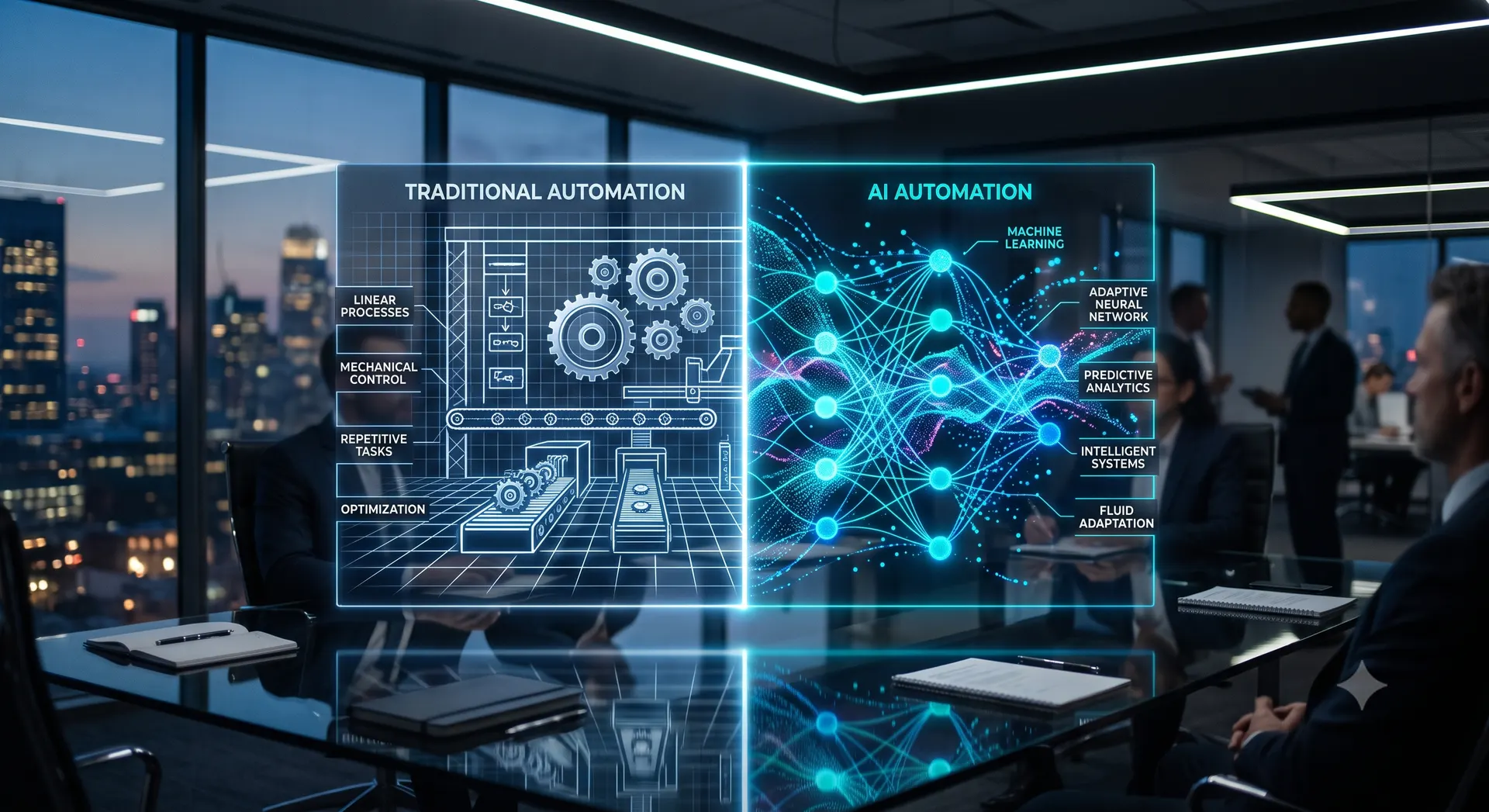
The mandate for corporate leadership is no longer about deciding whether to automate; it is about deciding how to automate intelligently. In boardrooms across the globe, executives are bombarded with overlapping terminology: Robotic Process Automation (RPA), machine learning, autonomous agents, and generative workflows.
For operational directors and CTOs tasked with driving efficiency and reducing overhead, this technological noise creates a strategic dilemma. Investing heavily in the wrong type of automation can lead to rigid systems that break under pressure, or conversely, overly complex AI platforms that fail to deliver a measurable return on investment.
To navigate this landscape, business leaders must clearly distinguish between traditional automation and AI-driven automation. Understanding where each excels and where they fail is the foundational step in engineering a resilient, high-performance enterprise.
Understanding Traditional Automation: The Rule-Based Engine
Traditional automation, often synonymous with Robotic Process Automation (RPA) and standard script-based macros, operates on a strict, deterministic framework. It is fundamentally a rule-based engine built on "if-this-then-that" logic.
When you deploy traditional automation, you are programming a system to replicate human keystrokes or data transfers within a highly controlled environment. If a shipping company wants to automatically copy customer addresses from a standardized digital form and paste them into a dispatch ledger, traditional automation handles this flawlessly.
The Strengths of Traditional Automation:
- High Predictability and Speed: Because it follows rigid rules, traditional automation executes repetitive tasks with flawless precision and zero fatigue, provided the environment remains constant.
- Immediate Operational Relief: It is highly effective for high-volume, low-complexity tasks like migrating data between legacy systems, generating standard daily reports, or processing structured payroll files.
- Lower Barrier to Entry: Developing traditional automated scripts is generally faster and requires less computational overhead than training a machine learning model.
The Fatal Flaw: Traditional automation lacks cognitive flexibility. It cannot think, adapt, or interpret. If a vendor sends an invoice in a slightly different format, or if a digital form is updated with a new layout, the traditional automation script will instantly break and require human intervention to fix the code. It demands perfectly structured data to function.
The Shift to AI Automation: The Cognitive Engine
Artificial Intelligence automation represents a fundamental leap from executing rules to interpreting context. By leveraging machine learning, natural language processing (NLP), and computer vision, AI automation does not just follow instructions it processes unstructured information, recognizes complex patterns, and makes autonomous micro-decisions.
Instead of demanding a perfectly structured spreadsheet, an AI-powered system can read an unstructured email from a frustrated client, understand the sentiment, extract the relevant contract number, and automatically route the ticket to the correct department with a drafted response.
The Strengths of AI Automation:
- Handling Unstructured Data: AI thrives in the messy reality of modern business. It can parse PDFs, interpret scanned documents, and understand conversational language, turning unstructured chaos into structured, actionable data.
- Continuous Learning and Adaptability: Unlike traditional scripts that break when conditions change, machine learning models improve over time. As they process more variations of a task, their accuracy and resilience increase.
- Advanced Executive Decision Making: AI automation transitions technology from a back-office tool into a strategic partner. It can forecast supply chain disruptions, dynamically adjust pricing models, and flag compliance anomalies before they become liabilities.
The Enterprise Dilemma: What Should Businesses Choose?
The industry narrative often positions this as an "either/or" battle, but sophisticated organizations understand that optimal Enterprise Digital Transformation requires both. The choice depends entirely on the nature of the specific business workflow.
If a process is highly standardized, repetitive, and relies entirely on structured data (like standardizing entries in a ledger), traditional automation remains the most cost-effective solution.
However, if a process involves variability, unstructured data, or requires human-like judgment (like dynamic fraud detection, complex customer service routing, or predictive maintenance), AI automation is strictly required.
At Unovative, we engineer hybrid architectures. As a premier software development company in Palghar, we often utilize traditional automation as the muscle to move data between legacy systems, while implementing AI as the brain that interprets and decides what to do with that data.
Strategic Implementation and Finding the Right Partner
Transitioning from chaotic manual processes to a streamlined, automated future requires rigorous architectural discipline. Many companies attempt to cut costs by outsourcing their core architecture to a generic custom software development Vietnam agency, only to find that the resulting software lacks the deep contextual understanding of their specific industry operations, leading to massive technical debt.
True transformation requires an engineering partner that understands business strategy just as well as they understand code. As the Best IT Company in Palghar and a highly sought-after custom software development company in Mumbai, we focus on Business Process Optimization before a single line of code is written.
- The Consulting Foundation: Through our Custom AI Software Consulting, we audit your workflows to determine exactly which tasks require cognitive AI and which require simple rule-based scripts.
- Data Infrastructure: If your goal is intelligent automation, your underlying data must be sanitized. As an experienced ERP software development company, we build the robust data pipelines necessary to fuel advanced machine learning models.
- Custom Deployment: Whether you need standard Workflow Automation Software to handle administrative bottlenecks or a sophisticated agentic platform, our role as a leading IT company in Palghar is to build secure, scalable solutions that integrate seamlessly into your daily operations.