
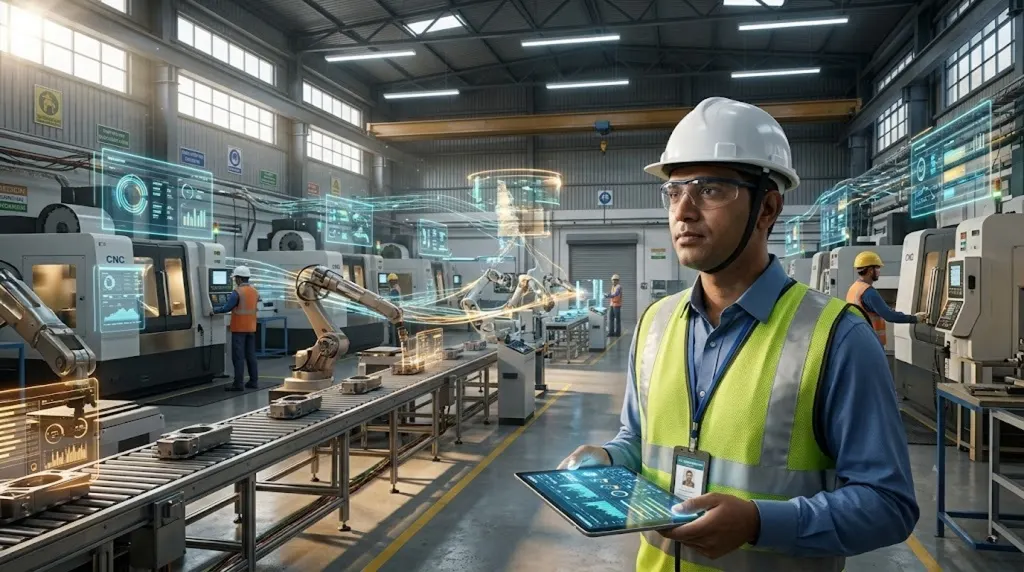
The Mumbai Metropolitan Region is home to thousands of factories. They run across belts such as Thane-Belapur, Taloja, Bhiwandi, Vasai and Tarapur MIDC near Boisar. Many of these units still plan production on whiteboards, track stock in Excel and share updates over WhatsApp.
That works until the business grows. Digital transformation in manufacturing is how factories close that gap. It means using connected software, clean data and simple automation so that work moves faster and decisions rest on facts, not guesswork.
This guide is for owners, plant heads and operations managers of small and mid-sized manufacturers in and around Mumbai. It explains where efficiency is usually lost, which areas to fix first, and how to plan a realistic, phased roadmap.
The efficiency gaps most Mumbai factories face
Every plant is different, but the same problems appear again and again:
- Production status is known only by walking the shop floor or calling a supervisor.
- Stock figures in the system do not match what is in the store.
- Machines break down without warning, and repair history lives in someone's memory.
- Quality checks are recorded on paper, so defects are hard to trace back to a batch.
- Management reports are prepared by hand and arrive days after they are needed.
None of these problems is dramatic on its own. Together, they slow down dispatch, tie up cash in excess inventory and make it hard to promise delivery dates with confidence.
The biggest loss usually comes from systems that do not talk to each other. Sales may use one tool, accounts another and the shop floor none at all. Each team re-enters the same data, and every handover is a chance for error.
A connected setup removes that double work. One order flows from sales to planning, production, quality, dispatch and billing without being typed again.
What digital transformation actually means on the shop floor
Digital transformation is not about buying the latest tools. It is about changing how work runs, using technology where it clearly helps.
For a manufacturer, that usually means three things:
- Process: a clear, agreed way of doing each job.
- Data: accurate, real-time information captured once, at the source.
- Software: systems that connect people and processes, and turn data into decisions.
If the process is broken, software will only make the mess faster. That is why good projects start with the workflow, not the technology.
Where Mumbai Manufacturers Can Improve Efficiency First
Digital transformation in manufacturing does not mean digitizing everything at once. Start where the pain is highest and the payoff is easiest to see.
1. Production planning and tracking
Production tracking software lets supervisors log job progress from a tablet or phone. Planners can then see which orders are on time, which are delayed and where bottlenecks form. This alone can cut the daily round of status calls and help sales give customers accurate delivery dates.
2. Inventory and procurement
Digital stock records linked to purchase orders show what is on hand, what is reserved and what needs reordering. Reorder alerts reduce both stock-outs and overstocking, freeing up working capital that is otherwise locked in the store room.
3. Machine maintenance
A simple maintenance log, with scheduled service reminders, is a strong first step. Over time, machine data from sensors can show patterns that point to a coming failure. The goal is to move from "fix it when it breaks" to planned maintenance that protects output.
4. Quality control
Digital inspection checklists record results against each batch, shift and machine. When a defect appears, the team can trace it to its source in minutes rather than days. This also makes audits and customer quality reviews far easier.
5. Management reporting and dashboards
When data is captured at the source, reports build themselves. A live dashboard can show output, rejection rates, pending orders and stock value in one place. Owners can review the business on a phone instead of waiting for a month-end spreadsheet.
Many manufacturers start with packaged software and find it does not fit how they work. Others need a system shaped around their own products, costing and approval rules. A custom ERP built by an experienced ERP software development company can fit your process closely, while a packaged product may be quicker to start. The right answer depends on how unique your workflow is and how much it matters to your margin. Unovative's article on custom ERP vs traditional ERP explains this trade-off in more detail.
A Practical, Phased Roadmap for Digital Transformation in Manufacturing
Big-bang projects often fail. A phased approach lowers risk and shows results early, which keeps the team on board.
- Map your current process. Walk through how an order moves from enquiry to dispatch. Note every handover, delay and spreadsheet.
- Pick one high-impact problem. Choose the issue that costs the most time or money, such as late dispatch or stock mismatches.
- Clean up the data. Standardize item codes, units and customer records before you build anything on top of them.
- Run a focused pilot. Digitize one line, one department or one process. Measure the before-and-after results.
- Integrate and scale. Connect the pilot to accounts, sales and other systems, then extend it to more areas.
- Train and support your people. Operators and supervisors must find the system easier than the old way, or they will quietly go back to paper.
Common mistakes to avoid
- Buying software before defining the process it should support.
- Ignoring shop-floor users when designing screens and workflows.
- Trying to automate everything in the first phase.
- Treating the project as finished on go-live day. Systems need to evolve as the business changes.
User adoption deserves special attention. Unovative has written about why internal business software often fails user adoption and how to avoid it.
Support available to Maharashtra manufacturers
Manufacturers do not have to plan digital transformation in manufacturing alone. The Ministry of Heavy Industries runs the SAMARTH Udyog Bharat 4.0 initiative to spread awareness of smart manufacturing. According to a Rajya Sabha answer from December 2024, one of its four main centres is the Centre for Industry 4.0 (C4i4) Lab in Pune, Maharashtra. These centres offer awareness programmes and workforce training. They are a useful starting point before you invest in a full rollout.
Academic research also confirms that the barriers are real. A 2024 study on Indian manufacturing SMEs set out to identify and model the obstacles that slow down digital transformation in this sector. Knowing these barriers in advance helps you plan around them.
How Unovative Can Help
Unovative is an IT and AI software company headquartered in Palghar, close to the Boisar and Tarapur industrial belt and within easy reach of Mumbai's manufacturing hubs. As a digital transformation company, we help manufacturers change how work actually runs, not just add new tools.
Our digital transformation services cover modernizing existing applications, automating operations and evolving live systems so they stay aligned with the business after go-live. Through our enterprise application services, we also build custom applications shaped around your workflow.
For a manufacturer, that can mean:
- Mapping your order-to-dispatch process before any code is written.
- Building production tracking, inventory or quality modules that fit your shop floor.
- Connecting disconnected tools so data is entered once and used everywhere.
- Creating management dashboards that show the numbers that matter.
- Adding AI and automation where it saves real time, not where it only looks impressive.
For digital transformation in manufacturing, we prefer to start small, prove value with a pilot and then scale. That keeps risk low and gives your team time to adopt the new way of working.
Explore Unovative's AI software, automation, and digital product services to learn more about its technology offerings.
Businesses can also read Why Businesses Outgrow Excel, WhatsApp and Manual Processes for further context on the challenges that can arise as operations grow.
Conclusion
Digital transformation in manufacturing is not a one-time purchase or a single software rollout. It is a steady shift towards connected processes, reliable data and systems that fit how your factory actually works.
For Mumbai-based industries, the gains are practical. Fewer status calls, accurate stock, planned maintenance, traceable quality and faster reports all add up to better use of time, cash and capacity.
The smartest way to begin is small. Map your current process, pick the one problem that costs you the most, and fix it with a focused pilot. Once that works, connect it to the rest of the business and scale step by step. Keep your shop-floor team involved at every stage, because a system people do not use will not improve efficiency.
Manufacturers that start now, even with one well-chosen improvement, will be better placed to win orders, meet delivery dates and grow without adding manual work.
Ready to take the first step? Book a 30-minute intro call with Unovative. Tell us the problem you want to solve, and we will help you map a realistic, phased plan for your factory.