
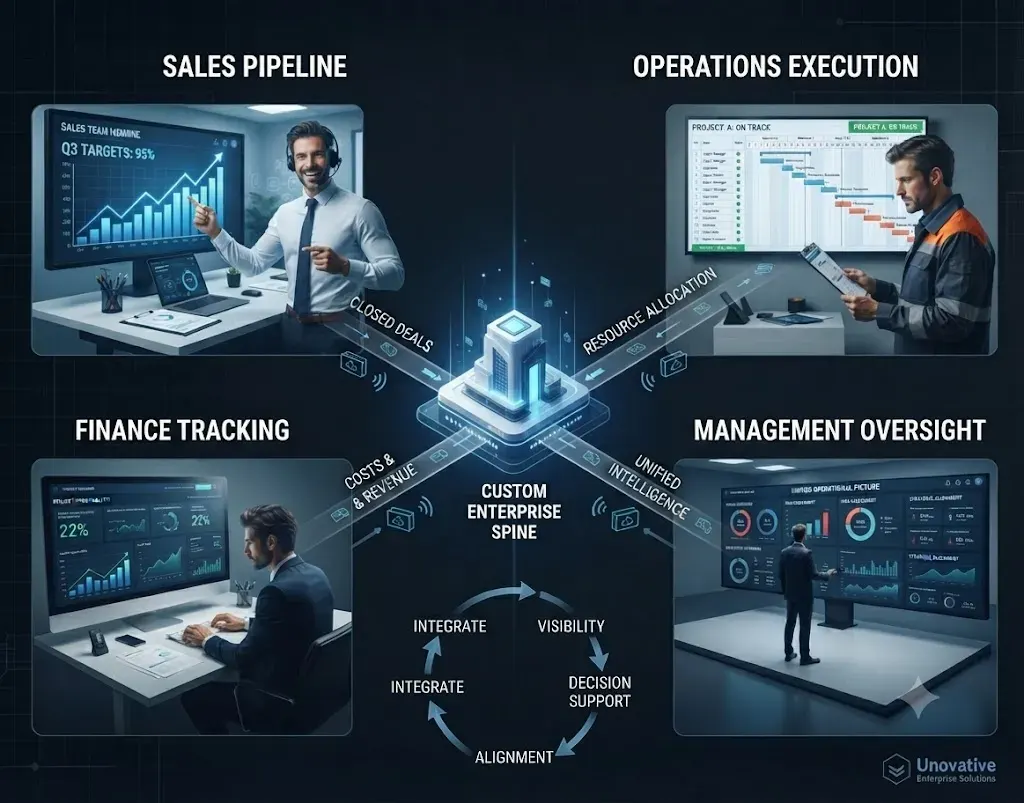
In many growing enterprises, departments operate in isolated silos. Sales chases revenue targets using CRM pipelines, operations manages execution through legacy logs and disparate tools, finance tracks ledgers in separate accounting platforms, and management reviews retrospective summary reports.
When these core pillars do not communicate seamlessly, businesses suffer from fragmented data, delayed approvals, and misaligned priorities. Off-the-shelf software often forces companies to adapt to rigid workflows, leaving gaps between departments. Custom software bridges these gaps, acting as the connective tissue that aligns sales, operations, finance, and management into a single, cohesive engine.
1. Bridging the Gap Between Sales and Operations
A sale is only as good as the company's ability to deliver on it. When sales and operational systems are disconnected, handoffs become a major source of friction:
- Real-Time Visibility: Custom software allows closed deals to instantly trigger operational workflows, automatically notifying project teams, provisioning resources, or updating inventory requirements without manual data entry.
- Managing Expectations: Operations gains early visibility into incoming pipelines and customer requirements, preventing capacity bottlenecks and ensuring that sales promises match delivery realities.
2. Streamlining Financial Tracking and Resource Allocation
Finance should not have to chase down departments for updates or reconcile mismatched spreadsheets to understand the company's financial health:
- Integrated Workflows: By embedding financial logic directly into daily operational and sales tools, custom applications track expenses, project milestones, and resource utilization as work happens.
- Accurate Forecasting: Management and finance teams receive real-time visibility into project profitability, cash flow, and resource burn rates, enabling sharper strategic planning rather than reactive budgeting.
3. Empowering Management with a Unified Operational Picture
Executives and managers need clear, reliable intelligence to steer the enterprise effectively, not a patchwork of conflicting reports from different software packages:
- The Analytical Layer: Custom solutions introduce a centralized analytical layer that aggregates data across departments, turning passive records into dynamic, actionable dashboards.
- Contextual Decision Support: Instead of manually compiling updates from multiple sources, leaders can instantly evaluate performance metrics, identify operational risks, and align team efforts toward common corporate objectives.