
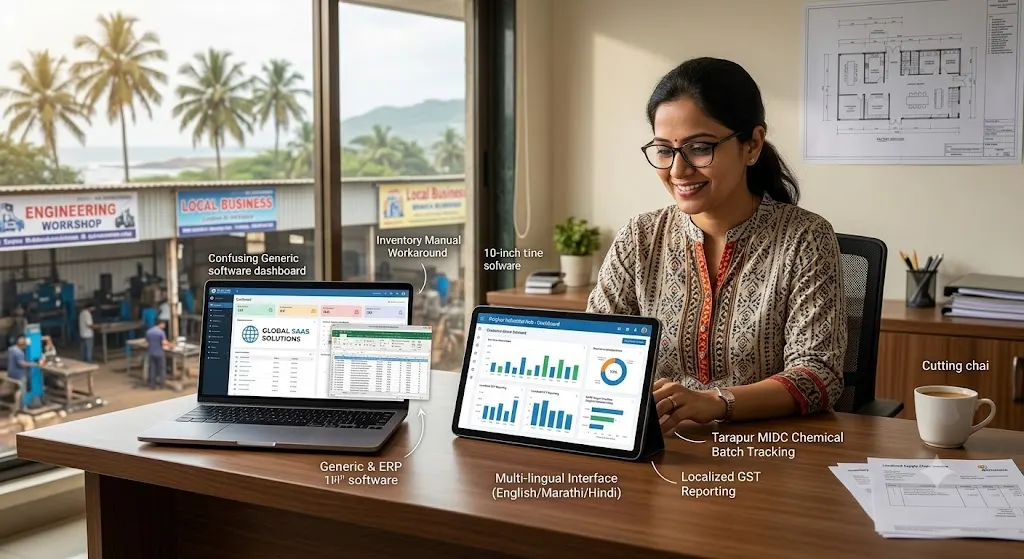
Despite massive industrial expansion and infrastructure modernization efforts across Maharashtra, a surprising number of growing enterprises in the Palghar district still rely on generic, off the shelf software to manage their core operations. From the complex supply chain logistics humming inside the Tarapur Maharashtra Industrial Development Corporation (MIDC) to high stakes chemical manufacturing, textiles, and large-scale agricultural distribution, the sheer volume of fragmented data flooding local back offices is staggering.
The reality of the modern industrial landscape is that rigid, one size fits all SaaS products are no longer financially or operationally viable for organizations looking to scale aggressively. Relying on generic applications forces companies to adapt their unique, hard-earned workflows to the limitations of the software. This backward approach creates severe operational bottlenecks, compliance gaps, and unacceptably high error rates.
To remain competitive in a rapidly evolving market, executive leadership must pivot from traditional, bloated software subscriptions to scalable, custom-engineered digital architectures. Here is an in-depth look at why customized software is the defining competitive advantage for Palghar businesses today.
1. The Hidden, Escalating Costs of Off the Shelf SaaS
For years, companies relied on generic cloud subscriptions combined with manual spreadsheet workarounds to plug the gaps. While this seems cost effective on day one, the long-term financial reality is entirely different. Traditional SaaS is completely dependent on rigid data models; if a local supplier requires localized billing formats or unique inventory metrics that fall outside the software’s default settings, the platform fails.
This inflexibility carries a massive financial impact. Off the shelf tools almost universally operate on a "pay-per-user" subscription model. As a business in Palghar hires more staff to keep up with regional growth, these monthly fees multiply rapidly. Furthermore, subscription fatigue and feature bloat mean enterprises are paying premium licensing fees for hundreds of generic modules they will never use.
By transitioning to a custom built platform, organizations eliminate these recurring, user based license fees. While the initial investment of building custom software is higher, the Return on Investment curve quickly overtakes SaaS. You transition from endlessly renting rigid software to owning a core digital asset that directly boosts executive decision-making and operational agility.
2. Deep Alignment with Palghar’s Specialized Industrial Workflows
Palghar is not a monolithic business environment; it is home to highly specific, localized industries that generic software simply isn’t built to handle. Custom software is built directly around your actual daily workflows, eliminating the need for awkward manual workarounds.
- Manufacturing, Pharmaceuticals, and Chemicals (Tarapur MIDC): The Tarapur industrial sector leads the demand for custom solutions because of its overwhelming volume of specialized compliance and tracking needs. With hundreds of fine chemical, pharmaceutical, and steel manufacturers operating in the zone, standard inventory tools are insufficient. Custom software can track specific raw material batches, execute complex quality control algorithms, and manage highly nuanced machinery maintenance schedules that prevent catastrophic downtime.
- Agriculture, Fisheries, and Cold Chain Logistics: A business managing the distribution of Palghar’s famous agricultural yields or coastal fisheries needs distinct logistics protocols. Custom applications integrate cold-chain IoT temperature tracking, shelf life management, and localized routing that standard retail or warehouse software simply cannot accommodate.
- Textiles and Heavy Engineering: For businesses managing massive bills of materials (BOMs), custom ERP solutions ensure that raw material procurement perfectly aligns with shop-floor production schedules, reducing idle time and material waste.
3. Embedding Company Processes, Training, and QA
One of the most significant friction points for expanding businesses is maintaining quality and consistency as the workforce grows. Generic HR and operations software generally provide empty templates that fail to capture the nuance of how a specific company actually runs.
Custom software allows businesses to bake their exact corporate Standard Operating Procedures (SOPs) directly into the digital infrastructure. Instead of relying on external documents or disconnected handbooks, custom systems integrate automated onboarding workflows, role specific training modules, and real-time Quality Assurance checklists into the daily user interface. When a new machine operator or floor manager is hired, the custom software guides them strictly through the company's approved processes, ensuring that QA standards are met at every single operational touchpoint before the system allows them to move to the next task.
4. Multilingual Interfaces and Targeted Mobile Optimization
A major reason enterprise software implementations fail is a lack of user adoption on the warehouse or factory floor. Generic software is typically designed for a global, English speaking audience sitting at desktop computers.
In Palghar, your warehouse staff, assembly line workers, and local logistics vendors may be much more comfortable, and faster, operating in Marathi or Hindi. Custom software allows developers to build true multi-lingual interfaces tailored to your workforce's native languages. This drastically reduces training time, minimizes costly data entry errors, and boosts overall workforce productivity.
Furthermore, custom software allows businesses to design mobile first interfaces optimized exactly for the devices their field workers actually use. Instead of clunky desktop ports, custom applications can be fine-tuned to specific mobile dimensions such as a 384 x 854 resolution ensuring that scanning tools, QA forms, and inventory tracking buttons render perfectly on company-issued handhelds without frustrating zooming, scrolling, or pixelation.
5. Mastering Local Regulatory Compliance and Data Security
Indian enterprises face some of the strictest, most dynamic regulations regarding taxation, local labor laws, and data localization. While top-tier generic software tries to keep up with national changes, they frequently miss state-level or hyper-local industrial zone nuances.
Custom software can be hard coded to automatically generate compliance reports formatted exactly for Maharashtra's specific state requirements. Whether it is automatically generating e-way bills for local transit, structuring data for precise GST filings, or compiling environmental safety compliance logs required for MIDC factories, a customized system saves accounting and legal teams countless hours of manual reconciliation. Additionally, owning your software means you control your data environment completely, implementing role based access control and ensuring proprietary business data never sits on a shared, multi-tenant public SaaS server.
6. Architecting True Scalability and Seamless Integration
Many growing businesses in Palghar suffer from trapped, fragmented data. The sales team uses a generic CRM, HR uses a separate payroll app, accounting uses legacy desktop software, and the warehouse relies on a complex web of Excel spreadsheets.
Deploying enterprise grade digital infrastructure requires meticulous data pipelines and a deep understanding of corporate operational friction. Custom software acts as a unified digital hub. You can build a centralized ecosystem that seamlessly integrates with local payment gateways (like UPI/NPCI), your legacy accounting systems, and external vendor APIs.
Palghar is developing rapidly due to its proximity to Mumbai and massive ongoing infrastructure projects like the bullet train and coastal roads. A generic system that barely manages a single warehouse today will completely buckle when you open three more branches next year. Custom software is engineered with your specific growth trajectory in mind. When you expand, an API first custom architecture scales horizontally, allowing you to add new facilities, user roles, and operational capabilities without requiring a painful, expensive data migration to a completely new platform.
Conclusion: Partnering for Digital Excellence
The era of manual back-office administration, fragmented spreadsheets, and inflexible software is rapidly coming to an end. Deploying successful custom software demands secure architecture and localized architectural leadership.
By partnering with a premier custom software development company in Palghar, forward thinking enterprises are auditing their operational lifecycles, centralizing their data, and eliminating friction. In doing so, they are transforming their operational infrastructure from a rigid monthly expense into their most valuable, real-time competitive asset.