
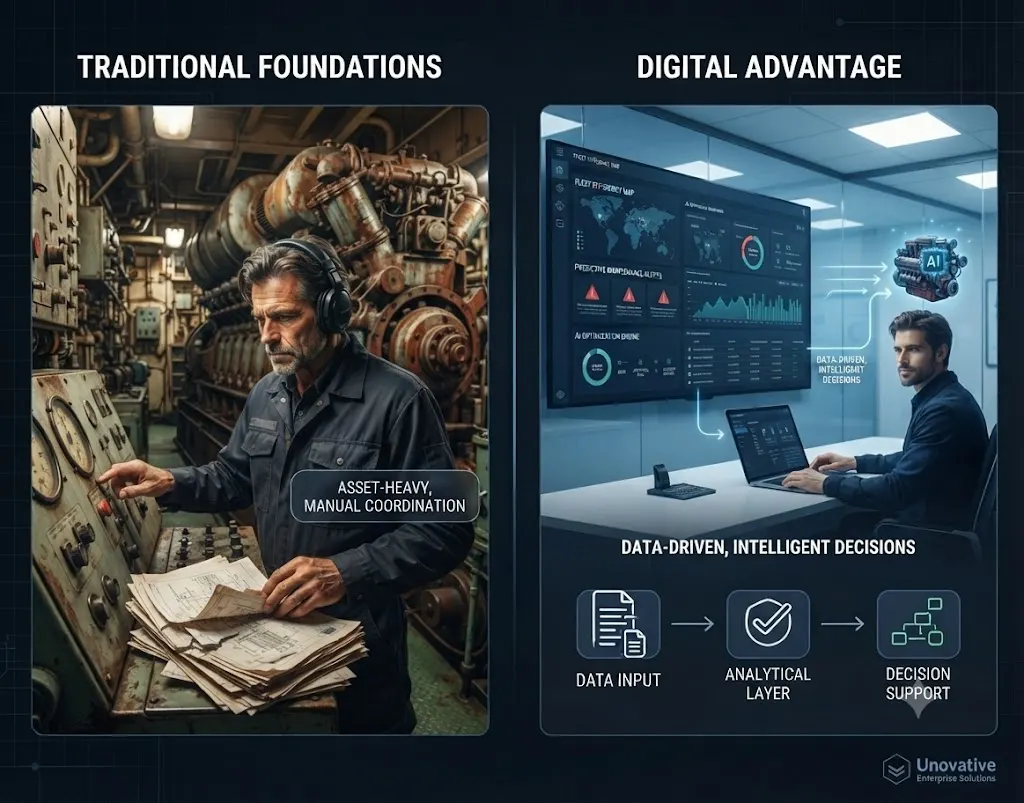
For decades, traditional sectors such as maritime, manufacturing, logistics, and heavy industry relied primarily on physical assets, long-standing operational expertise, and manual coordination. In these asset-heavy environments, technology was viewed strictly as a back-office utility - a system of record used to log transactions or archive historical records rather than an active driver of market differentiation.
Today, that paradigm has fundamentally shifted. As global markets grow more volatile and operational complexity increases, technology has become the primary wedge for competitive advantage. Companies that successfully bridge traditional industry expertise with modern software and artificial intelligence are redefining efficiency, resilience, and scale.
1. Moving from Passive Recording to Intelligent Decision Support
Traditional enterprise software has historically excelled at gathering data: machinery logs, inventory metrics, compliance forms, and financial reports. However, collecting information is no longer a bottleneck; interpreting it quickly enough to act is.
- The Analytical Layer: Modern technological integration introduces an analytical layer that transforms passive databases into active, intelligent decision-support systems.
- Proactive Interventions: Instead of waiting for fixed maintenance schedules or reviewing retrospective reports, organizations use real-time data insights to anticipate bottlenecks, forecast operational hurdles, and optimize workflows before minor issues escalate into costly downtime.
2. Operational Resilience Through Visibility and Automation
In complex sectors like shipping or global supply chains, fragmented communication across dispersed teams creates massive operational drag. Technology creates a unified operational picture.
- Streamlining Fragmentation: Consolidating disparate data streams - ranging from procurement platforms and maintenance records to regulatory filings - eliminates the administrative overhead of searching through siloed files and emails.
- Workflow Automation: Intelligent tools and agentic workflows can triage incoming operational updates, cross-reference technical documentation, and coordinate cross-departmental responses while keeping qualified professionals firmly in the loop for critical approvals.
3. Cultivating a Culture of Strategic Innovation
Adopting technology as a competitive advantage is not about implementing tools for the sake of trends or buzzwords; it requires a disciplined, human-centered strategy.
- Problem-First Adoption: Successful digital transformation begins by identifying tangible business friction points - such as slow approval loops, recurring delays, or fragmented data - rather than chasing emerging technologies blindly.
- Amplifying Human Expertise: The ultimate goal of advanced enterprise technology is not to replace professional judgment, but to lift the cognitive burden off teams, enabling them to focus their energy where their expertise matters most.