
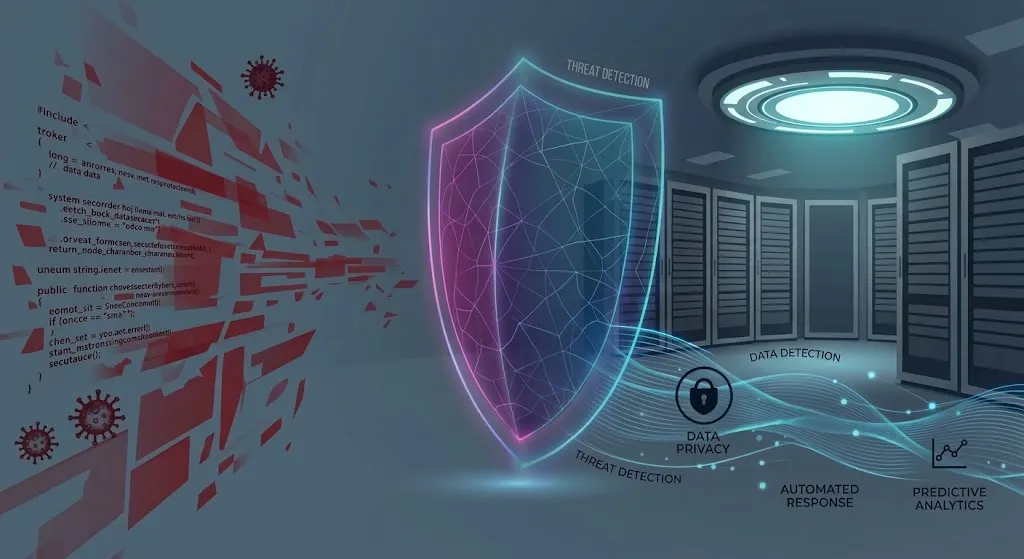
Cyber attacks are a growing risk for modern businesses. Traditional security tools such as firewalls and antivirus software remain important, but they are not always enough to handle today's rapidly changing threats. Attackers are using more sophisticated techniques to target business networks, applications, employees, and sensitive data.
Artificial intelligence (AI) is changing how businesses approach cybersecurity. AI-powered systems can analyze large amounts of data, identify unusual behavior, detect potential threats, and help security teams respond faster.
However, AI is not only being used by defenders. Cybercriminals can also use AI to create more convincing phishing messages, automate attacks, and improve existing techniques. Businesses therefore need to understand both the benefits and risks of AI in cybersecurity.
This is especially important for businesses in industrial and commercial regions such as Palghar, Boisar, and Tarapur MIDC, where companies increasingly depend on software, cloud platforms, connected devices, and digital business systems.
In this article, we explore how AI is changing cybersecurity, its major benefits and risks, real-world applications, and practical steps businesses can take to improve their security.
Why Traditional Cybersecurity Is Not Enough
Traditional cybersecurity tools often rely on predefined rules, signatures, and known threat patterns. For example, antivirus software may identify malware based on characteristics associated with previously detected threats.
The challenge is that cyber threats constantly evolve. New malware, phishing techniques, vulnerabilities, and attack methods can appear before traditional security systems have enough information to recognize them.
Security teams also have to deal with large volumes of alerts and network activity. Reviewing every event manually can be time-consuming and can increase the possibility of missing important warning signs.
This is where AI can provide additional support.
AI-powered cybersecurity systems can analyze large amounts of security data and identify patterns that may indicate suspicious activity. Instead of relying only on known threats, these systems can also use behavioral analysis and anomaly detection to identify activity that differs from normal patterns.
The Major Benefits of AI in Cybersecurity
Artificial intelligence can support businesses in several areas of cybersecurity. Here are some of the most important applications.
1. Faster Threat Detection
One of the biggest advantages of AI in cybersecurity is its ability to analyze activity continuously.
An AI-powered security system can monitor network traffic, login activity, file access, devices, and other signals to identify unusual behavior.
For example, imagine an employee account that normally accesses a small number of files during working hours suddenly starts downloading a large amount of sensitive data late at night. An AI-powered system can identify this unusual behavior and alert the security team.
Faster detection can give businesses more time to investigate and respond before a security incident becomes more serious.
2. Automated Incident Response
Detecting a threat is only part of cybersecurity. Businesses also need to respond quickly.
Depending on the security system and its configuration, AI can help automate certain responses to suspicious activity. For example, a system may temporarily block a suspicious account, isolate a compromised device, or restrict access to a particular resource.
Automation can reduce the time between detection and response. Human security professionals can then investigate the incident and decide what further action is required.
AI should support security teams rather than completely replace human decision-making, particularly when business-critical systems or sensitive information are involved.
3. Identifying Potential Risks
AI can analyze historical security events and current activity to help identify potential risks.
Instead of waiting until an attack happens, businesses can use security analytics to identify unusual behavior, vulnerable systems, and suspicious patterns.
For example, repeated failed login attempts from unusual locations may indicate an attempted account compromise. Detecting such patterns early can help a business strengthen its security controls before the situation escalates.
This proactive approach is an important part of modern cybersecurity strategy.
4. Handling Large Amounts of Security Data
Modern businesses generate large amounts of digital information every day. Network logs, authentication records, application activity, emails, cloud events, and endpoint data can create thousands or even millions of security events.
Security teams cannot manually investigate every event.
AI can help analyze large volumes of security data and prioritize activity that requires human attention. This can make security operations more efficient and help teams focus on the most important alerts.
The Hidden Risks: How AI Can Help Cybercriminals
AI provides significant opportunities for cybersecurity, but attackers can also use the technology to improve their methods.
Businesses should understand these risks when developing their security strategy.
Smarter Phishing Attacks
Phishing remains one of the most common ways attackers try to trick people into revealing sensitive information.
Older phishing emails were sometimes easy to identify because of poor grammar, spelling mistakes, or unusual wording. AI can make fraudulent messages more convincing by helping attackers create professional-looking content and imitate communication styles.
Attackers may also use publicly available information about employees or organizations to make messages appear more relevant.
This means employees cannot rely only on spelling mistakes or obvious warning signs. Businesses need security controls, employee awareness training, and strong email protection.
More Adaptive Malware
Cybercriminals can use AI and automation to improve different parts of the attack process.
For example, attackers may use automated techniques to identify potential targets, modify attack methods, or analyze information about a target environment.
This can make some threats more difficult to detect using security controls that rely only on known signatures.
Businesses should therefore combine traditional security controls with behavioral monitoring, endpoint protection, access controls, and regular security updates.
False Security Alerts
AI-powered security systems are not perfect.
Sometimes, legitimate activity may be incorrectly identified as suspicious. This is known as a false positive.
If a system generates too many unnecessary alerts, security teams may become overwhelmed. Over time, excessive alerts can make it harder to identify genuinely dangerous activity.
AI security systems therefore need proper configuration, continuous monitoring, and human review.
Data Privacy Concerns
AI cybersecurity systems may analyze emails, files, network activity, user behavior, and other business information.
This creates important privacy and data protection considerations.
Businesses should understand what information their security tools collect, where that information is stored, who can access it, and how it is processed.
When developing custom software or integrating AI into business systems, security and privacy requirements should be considered from the beginning rather than added later.
Real-World Applications of AI in Cybersecurity
AI is already being applied across several areas of cybersecurity.
AI-Powered Email Protection
Email is a common channel for phishing, malicious attachments, and fraudulent links.
AI-powered email security systems can analyze factors such as sender behavior, message content, links, attachments, and communication patterns to identify potentially malicious messages.
Suspicious emails can then be flagged, quarantined, or blocked according to the organization's security policies.
Advanced Endpoint Security
Laptops, smartphones, tablets, and other connected devices are known as endpoints. Each endpoint can potentially become an entry point into a business network.
AI-powered endpoint security can monitor device behavior and identify unusual processes, files, or activities.
If suspicious behavior is detected, security systems may be able to isolate the affected device or alert the security team before the threat spreads further.
Securing Cloud Environments
Many businesses now rely on cloud platforms for applications, storage, communication, and collaboration.
Cloud security requires monitoring users, devices, applications, permissions, and access patterns.
AI can help identify unusual cloud activity, such as unexpected login locations, unusual access times, or abnormal file downloads.
This can be particularly useful for businesses with employees accessing systems remotely or from multiple locations.
Identity and Access Management
Stolen passwords can give attackers access to business systems.
AI can support identity and access management by analyzing login behavior and identifying unusual authentication patterns.
For example, if an account suddenly attempts to access a system from an unfamiliar location or device, the security system may request additional verification or trigger an alert.
This approach adds another layer of protection beyond passwords.
Cybersecurity Considerations for Businesses in Palghar
Businesses in Palghar and nearby industrial areas such as Boisar and Tarapur MIDC are increasingly dependent on digital systems.
Manufacturing companies, service providers, pharmaceutical businesses, logistics companies, and other organizations may use cloud applications, enterprise software, connected devices, digital communication tools, and online services as part of their daily operations.
As digital dependency increases, cybersecurity becomes an important business requirement.
Some practical areas businesses can focus on include:
- Protecting employee accounts and business email
- Using multi-factor authentication
- Keeping software and operating systems updated
- Monitoring unusual network and account activity
- Securing cloud applications and data
- Regularly backing up important business information
- Training employees to identify phishing attempts
- Reviewing access permissions regularly
- Having a clear incident response plan
AI can strengthen these controls, but it should be part of a broader cybersecurity strategy rather than treated as a single solution.
How Businesses Can Start Using AI for Cybersecurity
Adopting AI for cybersecurity requires careful planning. Businesses should avoid purchasing technology simply because it includes an AI feature.
Instead, organizations can follow a structured approach.
1. Assess Your Current Risks
Start by understanding your existing security environment.
Identify important business data, critical applications, connected devices, user accounts, and potential vulnerabilities.
This helps determine where AI-powered security tools could provide the most value.
2. Train Your Employees
Technology alone cannot eliminate cybersecurity risks.
Employees should understand how to recognize phishing attempts, suspicious links, unexpected attachments, fraudulent requests, and unusual login notifications.
Regular security awareness training can reduce risks caused by human error.
3. Upgrade Gradually
Businesses do not necessarily need to replace their entire security infrastructure at once.
Organizations can begin with areas such as email security, endpoint protection, identity management, or security monitoring.
Once these systems are working effectively, additional AI-powered security capabilities can be introduced where they provide measurable value.
4. Monitor and Review AI Systems
AI security tools require ongoing monitoring.
Security teams should review false positives, investigate important alerts, update policies, and verify that the system is working as expected.
AI should remain part of a controlled security process rather than operating without oversight.
5. Work With Technology Experts
Cybersecurity can become complex as businesses adopt more applications, cloud services, connected devices, and custom software.
Working with an experienced technology partner can help businesses evaluate their requirements, select appropriate solutions, and integrate security into their digital systems.
How Unovative Can Help
Unovative is a technology company in Palghar focused on building practical digital solutions for businesses.
Our work includes AI software development, enterprise applications, custom software development, and digital transformation solutions.
For businesses adopting AI or modern software systems, security needs to be considered alongside performance, scalability, usability, and data protection.
Our approach is focused on understanding the business requirement first and then identifying the appropriate technology and implementation strategy.
Whether you operate a manufacturing business, service company, or growing enterprise, secure technology can help create a stronger foundation for digital growth.
Conclusion
AI is changing cybersecurity by helping businesses analyze large amounts of security data, identify unusual activity, detect potential threats, and respond more quickly.
At the same time, cybercriminals can use AI and automation to make phishing, malware, and other attacks more sophisticated.
For this reason, businesses should not view AI as a replacement for traditional cybersecurity. Instead, AI should work alongside established security practices, trained employees, access controls, software updates, monitoring, and human expertise.
Businesses in Palghar, Boisar, Tarapur MIDC, and other growing industrial regions can benefit from taking a proactive approach to cybersecurity as their reliance on digital technology increases.
If you're exploring how to implement secure AI or software solutions for your business, Unovative can help you evaluate your technical requirements, identify suitable approaches, and plan the next steps.