
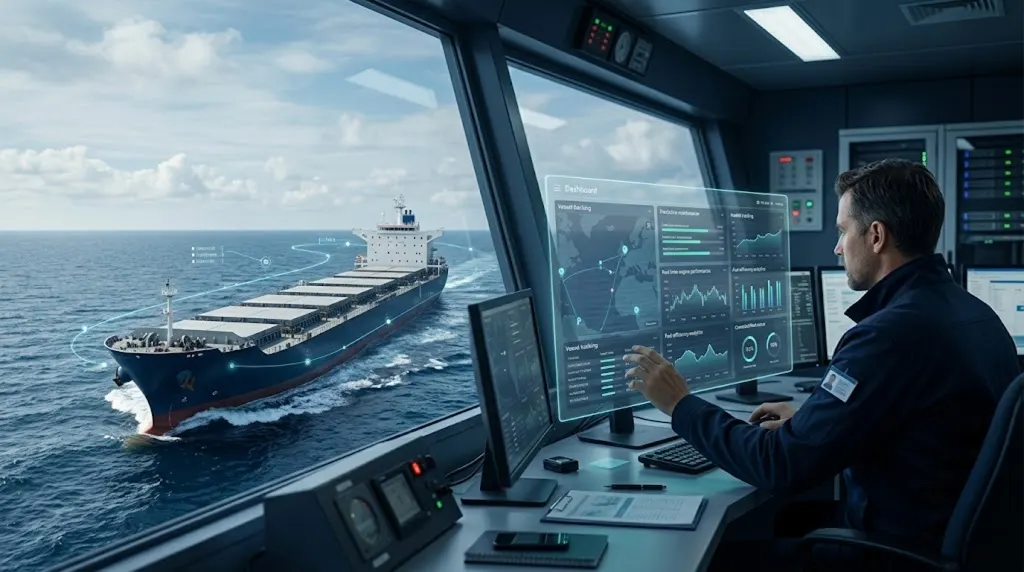
The maritime industry depends on safe vessels, reliable equipment, efficient voyages, and timely decisions. Yet many ship management companies still face challenges such as scattered maintenance records, manual reporting, unexpected equipment failures, and limited visibility across their fleets.
AI in ship management offers practical ways to address these challenges. By analysing operational data, identifying patterns, and helping teams spot potential problems earlier, artificial intelligence (AI) can support better decisions across technical management, vessel operations, and fleet planning.
For shipowners, fleet managers, technical superintendents, and maritime operations teams, the goal is not to automate every task. It is to give people better information, reduce repetitive work, and make vessel operations more predictable.
This article explores how AI can support technical and fleet teams, where it offers the most value, and what companies should consider before adopting it.
What Is AI in Ship Management?
AI in ship management refers to using artificial intelligence to analyse vessel data, support decisions, identify unusual patterns, and automate selected operational tasks.
Traditional software follows defined rules. AI systems can also identify patterns in historical and current data, helping teams recognise issues that may be difficult to spot through manual reviews alone.
For example, a conventional maintenance system might alert a technical team when a component reaches its scheduled service date. An AI-supported system could also analyse temperature, vibration, operating hours, and previous maintenance records to identify signs of unusual wear.
The result is additional information that helps the team decide whether an inspection or maintenance action is needed.
AI can support several areas of ship management:
- Technical maintenance and equipment monitoring.
- Fleet performance and fuel analysis.
- Voyage planning and operational reporting.
- Spare parts and inventory planning.
- Safety documentation and risk identification.
- Decision support for shore-based fleet teams.
The value depends on the quality of the available data, the reliability of the system, and how well it fits existing workflows.
1. Predictive Maintenance for Ship Equipment
Unexpected equipment failure can disrupt a vessel's schedule, increase repair costs, and create safety risks. Maintenance teams need to balance scheduled servicing with the actual condition of critical equipment.
AI-supported predictive maintenance helps teams identify possible problems before equipment fails.
How predictive maintenance works
An AI system can analyse information such as:
- Engine temperature and pressure.
- Vibration readings from machinery.
- Fuel consumption and operating hours.
- Equipment alarms and fault records.
- Previous inspections and repair history.
By comparing current readings with historical patterns, the system may identify unusual changes that deserve attention.
Imagine that a vessel's auxiliary engine begins showing a gradual rise in vibration levels. The engine may still be operating, and a standard maintenance schedule may not yet require an inspection.
An AI monitoring system could flag the change, display related readings, and notify the technical team. The superintendent could then review the evidence and decide whether further inspection is needed.
This approach may help teams plan maintenance during a suitable port call rather than respond to an unexpected breakdown at sea.
Important: AI predictions are indicators, not proof of an impending failure. Sensor faults, incomplete records, and changing operating conditions can affect results. Qualified engineers must validate important findings.
2. Smarter Fleet Performance Monitoring
Managing one vessel is different from overseeing a fleet with several ships, different operating profiles, and multiple technical teams.
Fleet managers need a clear view of performance across vessels. AI can help combine data from different sources and highlight the areas that require attention.
Consider a fleet manager reviewing five vessels. Each ship may produce separate reports, spreadsheets, and equipment logs.
An AI-enabled fleet dashboard could bring selected information into one view and flag which vessels need attention. Instead of reviewing every record manually, the manager could begin with the most important exceptions.
This does not remove the need for technical expertise. It helps the team use that expertise where it matters most.
3. Fuel Efficiency and Vessel Performance Analysis
Fuel is a major operating expense for many shipping companies. Small inefficiencies across multiple voyages can affect the overall operating budget.
AI can help teams understand how operating conditions relate to fuel consumption and vessel performance.
Identifying patterns in fuel use
A suitable system may compare fuel consumption with factors such as:
- Vessel speed and engine load.
- Cargo load and draft.
- Weather and sea conditions.
- Route and voyage duration.
- Hull or propeller performance indicators, where relevant data is available.
For example, if a vessel consumes more fuel than expected under comparable conditions, the system could flag the difference for investigation.
The technical team may then examine machinery performance, hull condition, operating practices, or the quality of the underlying data.
AI can also support voyage comparisons and help teams evaluate potential operating changes. However, recommendations must account for safety, weather, contractual commitments, arrival windows, and applicable regulations.
The practical benefit: AI can help identify where fuel efficiency may be improved, while the crew and fleet managers retain responsibility for operational decisions.
4. AI for Technical Superintendents and Maintenance Teams
Technical superintendents coordinate maintenance, inspections, repairs, technical records, and communication with vessels and service providers.
Much of this work involves reviewing documents and following up on outstanding tasks. AI can help reduce the time spent searching for information and preparing routine reports.
Technical applications that can save time
Maintenance record analysis: AI can summarise historical repair records and identify recurring issues across equipment.
Defect report classification: Systems can group incoming defect reports by equipment type, severity, or required follow-up, subject to review.
Inspection preparation: AI can help organise previous inspection findings, open maintenance items, and supporting documents into a review-ready summary.
Technical document search: A properly configured AI assistant can help staff locate relevant information in approved manuals, procedures, and internal records.
Work order support: AI can draft maintenance task descriptions, suggest relevant records to review, and highlight missing information.
Before an inspection, a superintendent may need to review open defects, previous repairs, maintenance schedules, and equipment documents.
Instead of collecting every record manually, an AI assistant could prepare a summary with references to the original documents. The superintendent can verify the information and use it to plan the inspection.
For safety-critical decisions, the original records and approved procedures must remain the source of truth. AI-generated summaries should never replace required inspections, technical judgement, or statutory documentation.
5. Spare Parts and Inventory Planning
Spare parts management can be difficult when vessels operate far from major suppliers or require components with long delivery times.
Holding too much inventory ties up capital, while holding too little can delay repairs.
AI can help analyse inventory usage, equipment history, delivery lead times, and planned maintenance requirements to support better stock planning.
Potential use cases
- Identify frequently used spare parts.
- Flag items that may fall below agreed stock levels.
- Estimate demand based on maintenance schedules and past usage.
- Highlight parts with long supplier lead times.
- Help compare inventory levels across vessels.
For instance, if a vessel has a planned maintenance task that requires a specific component, an AI-supported system could flag whether the part is available and whether replenishment may be needed.
These insights can help purchasing and technical teams coordinate earlier.
However, stock recommendations should account for criticality, manufacturer requirements, vessel-specific equipment, supplier reliability, and emergency reserves. AI should support inventory decisions, not make them without appropriate controls.
6. Voyage Planning and Operational Decision Support
AI can support voyage planning by helping teams analyse information from weather forecasts, vessel performance records, schedules, and operational constraints.
Potential applications include:
- Comparing feasible route options.
- Identifying weather-related schedule risks.
- Estimating arrival times using relevant operational data.
- Analysing differences between planned and actual voyage performance.
- Preparing voyage summaries for shore-based teams.
For example, a fleet operations team may use an AI-supported system to identify a potential delay and prepare alternative planning scenarios for review.
The system should clearly show the data and assumptions behind its recommendations. Navigational decisions must remain under the control of qualified personnel and comply with applicable safety requirements.
AI is most useful here as a decision-support tool, not as a substitute for the master, navigational officers, or approved navigation systems.
7. Automating Reports and Routine Fleet Administration
Technical and fleet teams often spend considerable time preparing daily reports, compiling vessel updates, following up on emails, and maintaining records.
AI-powered automation can help reduce this administrative workload.
Examples include:
- Drafting daily or weekly fleet summaries.
- Extracting selected information from approved documents.
- Organising incoming maintenance requests.
- Flagging incomplete reports.
- Summarising meeting notes and outstanding actions.
- Preparing draft responses to routine operational queries.
Imagine receiving several vessel reports at the start of a working day. An AI assistant could produce a consolidated summary showing reported defects, overdue actions, operational exceptions, and items requiring attention.
The team would then review the summary and confirm important details before taking action.
For reliable results, the system needs clear rules for data access, source references, approval, and record retention. Sensitive operational information should not be uploaded to unapproved AI services.
8. How AI Can Improve Safety and Risk Awareness
Safety is a core responsibility in ship management. AI may help teams organise risk information, detect unusual patterns, and prepare for reviews, but it cannot guarantee safe operations.
Depending on the data and system design, AI may support:
- Analysis of historical incident and near-miss reports.
- Identification of recurring equipment defects.
- Review of maintenance backlogs affecting critical equipment.
- Organisation of safety inspection findings.
- Search and retrieval of approved safety procedures.
- Preparation of risk assessment documents for qualified review.
For example, an organisation may discover that similar equipment defects are being reported across several vessels. An AI-supported analysis could group these reports and help technical leaders investigate whether a common issue exists.
The findings still need to be checked against the original reports and reviewed by responsible personnel.
Human oversight remains essential
The International Maritime Organization (IMO) adopted a non-mandatory International Code of Safety for Maritime Autonomous Surface Ships in May 2026, which took effect on 1 July 2026. The framework addresses the safe integration of remotely operated and autonomous commercial ships. It also emphasises risk management, cybersecurity, and human responsibility.
This development is relevant to the wider use of advanced maritime technology. It does not mean that ordinary AI-enabled fleet software automatically qualifies as an autonomous ship system or that AI removes existing safety responsibilities.
For conventional ship management, AI should operate within approved procedures, with clear escalation paths and qualified human oversight.
9. Challenges of Implementing AI in Ship Management
AI can create value, but successful adoption requires more than purchasing software. Ship management companies should assess their data, existing systems, security needs, and operational processes before implementation.
Poor data quality
AI relies on suitable data. Missing maintenance records, inconsistent equipment names, incorrect sensor readings, or incomplete reports can lead to unreliable results.
What to do: Standardise important records, check data quality, and establish clear ownership of vessel and equipment information.
Disconnected software systems
Maintenance, procurement, finance, and fleet operations may use different software platforms. If these systems cannot share information, teams may continue to work with fragmented records.
What to do: Identify which systems need to exchange data and assess available integration options before selecting an AI solution.
Cybersecurity and data privacy
Ship management systems may contain sensitive vessel, commercial, maintenance, and operational information. Poorly controlled AI access can expose this data to unauthorised users.
What to do: Apply role-based access, secure integrations, appropriate data retention policies, and monitoring. Follow relevant company security policies and maritime cybersecurity requirements.
Staff training and adoption
Technical teams may hesitate to trust recommendations that they cannot understand or verify.
What to do: Start with a clearly defined use case, explain how recommendations are produced, train staff, and collect feedback from the people who will use the system.
Unreliable or unclear recommendations
An AI system may produce an incorrect summary or flag a problem that does not exist.
What to do: Require source references, define confidence and escalation rules where appropriate, and ensure that important recommendations are reviewed by qualified personnel.
10. How to Implement AI in Ship Management Step by Step
A gradual approach can help ship management companies reduce risk and evaluate the practical value of AI before expanding its use.
Step 1: Identify a clear operational problem
Choose a specific challenge, such as recurring equipment faults, manual reporting, or poor visibility into maintenance tasks. Avoid starting with AI simply because it is a popular technology.
Step 2: Review available data
Check whether the required equipment readings, maintenance records, vessel reports, and historical data are available, consistent, and suitable for analysis.
Step 3: Select the right solution
Determine whether existing fleet software can support the use case or whether a custom application, AI assistant, or system integration is needed.
Step 4: Run a controlled pilot
Test the solution with a limited group of users or a suitable set of historical records. Compare its outputs with verified results and existing processes.
Step 5: Measure results and improve
Track indicators such as reporting time, overdue maintenance actions, false alerts, data accuracy, and staff adoption. Expand only when the pilot demonstrates useful and reliable results.
How Unovative Can Help
Ship management companies may need technology that fits their actual workflows rather than forcing every team to adopt a completely new system.
Unovative is an IT and AI software company based in Palghar, Maharashtra, with an international presence in Vietnam. Its publicly described offerings include custom digital products, intelligent applications, business automation, and technology consulting.
These capabilities are relevant when a maritime business wants to explore a tailored digital solution for a defined operational problem.
Depending on the requirements, a project could involve:
- Custom maritime applications: Designing software around specific fleet, vessel, or technical management workflows.
- AI-assisted information retrieval: Helping authorised staff search and summarise approved technical documents.
- Workflow automation: Reducing repetitive reporting, task assignment, and administrative follow-ups.
- Data dashboards: Bringing selected operational information into a more accessible view.
- System integration: Connecting suitable existing systems where supported interfaces and permissions are available.
These are potential solution approaches, not a claim that every maritime feature is an existing off-the-shelf Unovative product. The right scope would need to be assessed with the client.
For maritime businesses in Palghar, Boisar, and other commercial regions, the first step is to identify a specific operational challenge, review available data, and determine whether AI or conventional software would provide the most practical solution.
Explore Unovative's AI software and digital solutions or visit the contact page to discuss a potential project.
Conclusion: Making AI Practical for Ship Management Teams
AI in ship management is most valuable when it addresses real operational needs. Predictive maintenance can help identify equipment anomalies, fleet analytics can highlight performance trends, and AI-assisted automation can reduce the burden of routine reporting.
However, these benefits depend on reliable data, secure systems, well-defined workflows, and appropriate human oversight. AI recommendations should support qualified maritime professionals rather than replace their technical judgement or safety responsibilities.
Ship management companies do not need to transform every operation at once. Starting with one measurable problem, testing a suitable solution, and reviewing the results can provide a more practical path to adoption.
Looking to modernise your maritime operations? Connect with Unovative to explore custom software, AI, and automation approaches suited to your business needs.