
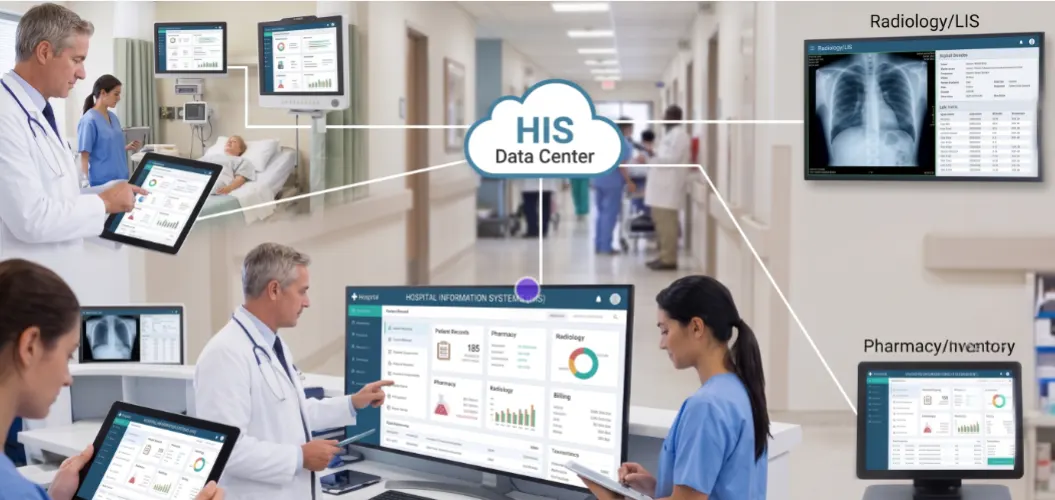
Healthcare software development helps modern hospitals connect patient records, appointments, billing, medical departments and administrative workflows. Learn how digital healthcare systems improve hospital operations, support better information management and prepare hospitals for future technology needs.
Modern hospitals manage large amounts of information every day. Patient registration, medical records, laboratory reports, appointments, billing and staff coordination all require accurate information and timely communication.
When these activities depend on separate systems or manual processes, hospitals can face delays, repeated data entry and communication gaps.
Healthcare software development helps address these challenges by connecting hospital operations through digital applications. Instead of managing every department separately, hospitals can use integrated software to organize information and simplify everyday work.
As healthcare requirements grow, hospitals need more than basic digital records. They need reliable software that supports their workflows, protects sensitive information and adapts to changing operational needs.
Why Modern Hospitals Need Healthcare Software
Hospital operations involve several departments that depend on one another. Doctors need patient histories, laboratories need test requests, billing teams need accurate service information, and administrators need operational reports.
When these activities are not connected, employees may spend additional time searching for information or updating multiple systems.
Common challenges include:
- Disconnected patient records: Medical information is stored across different systems or physical files.
- Manual administrative work: Employees spend time entering data and preparing reports.
- Appointment management problems: Scheduling and rescheduling can become difficult during busy periods.
- Communication gaps: Important updates may not reach the right department on time.
- Limited operational visibility: Management may struggle to understand resource usage and department performance.
- Data security concerns: Sensitive patient information requires proper access controls.
Digital healthcare systems help hospitals organize these activities and create more connected workflows.
Key Ways Healthcare Software Development Is Transforming Modern Hospitals
1. Electronic Health Records Improve Patient Information Management
Electronic Health Records (EHRs) allow hospitals to maintain patient information in digital formats.
Instead of relying entirely on paper files, authorized healthcare professionals can access relevant patient details through digital systems.
An EHR system can include:
- Patient medical history.
- Previous consultation details.
- Diagnosis and treatment records.
- Laboratory and diagnostic reports.
- Medication information.
- Allergy details.
- Follow-up appointments.
For example, when a returning patient visits a hospital, authorized medical staff can review available historical records without searching through multiple physical files.
This makes information retrieval easier and supports continuity of care.
Hospitals must ensure that records remain accurate, updated and accessible only to authorized users.
2. Hospital Management Software Connects Different Departments
Hospital Management Software helps coordinate administrative and operational activities through a connected platform.
Depending on hospital requirements, the system may include:
- Patient registration.
- Appointment scheduling.
- Doctor and staff management.
- Bed and ward management.
- Billing and payment records.
- Pharmacy inventory.
- Laboratory coordination.
- Administrative reporting.
Consider a hospital where reception, billing and appointment scheduling operate through separate tools.
A connected system can help authorized employees access relevant information without repeatedly entering the same details.
It can also give hospital administrators a clearer view of daily operations.
The software should match the hospital's actual workflows rather than forcing every department to follow an unsuitable process.
3. Workflow Automation Reduces Repetitive Administrative Work
Hospital employees handle many repetitive activities throughout the day. These include appointment reminders, report notifications, registration updates, billing documentation and internal requests.
Manual handling of these tasks takes time and creates opportunities for mistakes.
Healthcare workflow automation can simplify suitable activities.
Common examples include:
- Sending appointment confirmation messages.
- Notifying patients when reports are available.
- Routing requests to the correct department.
- Generating routine administrative reports.
- Sending follow-up reminders.
- Tracking pending administrative approvals.
For example, when a laboratory report is marked as ready, the system can notify the relevant authorized user or department.
This reduces the need for repeated manual follow-ups.
However, tasks involving clinical decisions, medication changes or urgent patient care must remain under qualified human supervision.
4. Telemedicine and Mobile Applications Improve Patient Access
Patients increasingly expect convenient ways to interact with healthcare providers.
Telemedicine platforms and mobile healthcare applications can support communication between hospitals and patients beyond physical visits.
Depending on the solution, features may include:
- Online appointment booking.
- Video consultations.
- Digital appointment reminders.
- Access to selected medical records.
- Follow-up communication.
- Prescription and report access.
- Patient support requests.
For example, a patient who needs a routine follow-up may be able to arrange an online consultation when the hospital and treating clinician consider it appropriate.
Mobile applications can also help patients track appointments and access important instructions.
Hospitals should ensure that these applications protect personal information and provide alternatives for patients who are not comfortable using digital tools.
5. AI and Data Analytics Support Hospital Management Decisions
Hospitals generate information through patient visits, diagnostic activities, appointments, inventory, billing and departmental operations.
When this information is organized properly, analytics tools can help administrators understand patterns and identify areas that need attention.
AI and data analytics can support:
- Identifying appointment demand patterns.
- Monitoring resource utilization.
- Analyzing administrative workloads.
- Reviewing inventory trends.
- Preparing operational reports.
- Identifying unusual patterns for further investigation.
For example, a hospital administrator could use a dashboard to review patient registration volumes across different departments.
This information may help the management team plan staff allocation and operational resources.
AI can also assist with administrative tasks such as document classification and information extraction.
Clinical applications require appropriate validation and human oversight. AI-generated information should not automatically be treated as a medical diagnosis or treatment recommendation.
6. Integrated Systems Improve Communication Between Departments
One of the biggest challenges in hospital operations is ensuring that information moves between departments correctly.
For example, a doctor may request a laboratory test. The laboratory team needs the relevant request details, and the doctor needs access to the completed report.
If these activities are handled through disconnected systems, employees may need to make additional calls or manually transfer information.
Integrated software can connect relevant systems through secure data exchange.
Important integration opportunities include:
- Electronic health records and laboratory systems.
- Pharmacy and inventory platforms.
- Billing and financial applications.
- Appointment and registration systems.
- Diagnostic imaging platforms.
- Hospital reporting dashboards.
Healthcare interoperability is an important part of this process.
HL7 FHIR (Fast Healthcare Interoperability Resources) is a standard designed to support the electronic exchange of healthcare information.
Hospitals and software developers can consider suitable interoperability standards when planning connections between different healthcare applications.
Read the official HL7 FHIR documentation to understand how structured healthcare data exchange works.
7. Cloud-Based Systems Support Scalability and Accessibility
Hospitals need technology that can support changing operational requirements.
Cloud-based software can provide flexible access to applications and data, depending on the architecture, deployment model and security controls.
Potential advantages include:
- Centralized application management.
- Easier access across approved locations.
- Flexible infrastructure capacity.
- Simplified software updates.
- Integration with other digital platforms.
- Centralized backup and recovery planning.
For example, a hospital group operating multiple facilities may want to maintain a connected administrative platform while allowing each location to manage its own operational activities.
A cloud-based approach may support this requirement.
However, hospitals must carefully consider data security, access permissions, availability, backups and regulatory requirements before adopting cloud infrastructure.
Essential Features Modern Hospitals Should Consider
Not every hospital needs the same software. A small hospital, a multi-specialty facility and a large hospital network may have different operational requirements.
Before selecting or developing a solution, decision-makers should identify the features that address their actual needs.
Important features may include:
- Patient management: Organizes patient registration and records.
- Appointment management: Simplifies scheduling and follow-ups.
- EHR integration: Supports access to digital medical records.
- Billing management: Organizes invoices and payment records.
- Laboratory integration: Connects test requests and reports.
- Pharmacy management: Helps track medicines and inventory.
- Analytics dashboards: Provides operational insights.
- Access controls: Restricts sensitive information to authorized users.
- Automated notifications: Reduces repetitive communication.
- Data backup: Supports recovery and business continuity.
The best approach is to prioritize essential workflows first and expand the system as hospital requirements develop.
Security and Patient Data Protection
Healthcare software handles highly sensitive information. A data breach, unauthorized access or accidental disclosure can affect patients and hospital operations.
Security should be considered from the beginning of software development.
Important measures include:
Role-Based Access Control
Doctors, nurses, receptionists, administrators and other employees should have access only to the information required for their responsibilities.
Data Encryption
Sensitive information should be protected during transmission and, where appropriate, while stored.
Audit Logs
Systems should maintain records of important activities, such as accessing, updating or exporting patient information.
Backup and Recovery
Hospitals should maintain tested backup and recovery procedures to reduce the impact of accidental data loss or system failures.
Privacy and Regulatory Requirements
Healthcare organizations operating in India should consider applicable requirements under the Digital Personal Data Protection Act, 2023, its applicable rules and relevant healthcare-sector requirements.
The Ministry of Electronics and Information Technology provides official information about India's digital governance and data protection framework.
Security is not a one-time development task. Hospitals need ongoing monitoring, maintenance, employee awareness and periodic reviews.
How Hospitals Can Choose the Right Software Development Approach
Selecting software is an important decision because the system may become part of daily hospital operations.
A practical selection process can help avoid unnecessary costs and implementation problems.
1. Understand existing workflows: Document how patients move through registration, consultation, testing, billing and discharge.
2. Identify operational problems: Find out where staff spend too much time, where information gets delayed and which activities require repeated manual work.
3. Define essential requirements: Separate must-have features from optional improvements.
4. Evaluate integration requirements: Check whether the proposed software can connect with existing applications and equipment.
5. Review security capabilities: Understand how the system handles user permissions, encryption, backups, audit records and data privacy.
6. Test with actual users: Involve doctors, nurses, administrators and other employees in usability testing before wider deployment.
7. Plan training and ongoing support: Employees need proper training, and hospitals need a clear process for reporting issues and requesting improvements.
Custom Software vs Ready-Made Healthcare Solutions
Hospitals generally have two options: adopt an existing product or develop software around their specific requirements.
Ready-made software often provides faster initial setup and standard features. However, customization and integration options may depend on the vendor.
Custom software can be designed around specific hospital workflows and integration requirements. It offers greater flexibility but requires development planning, testing and an agreed maintenance model.
There is no single option that suits every hospital.
A ready-made solution may be appropriate when its features match existing requirements. Custom development may be worth exploring when a hospital needs specialized workflows or integrations that existing products cannot adequately support.
How Unovative Can Help
Modern healthcare organizations need digital systems that are practical, secure and designed around real operational challenges.
Unovative is an IT and AI software company headquartered in Palghar, Maharashtra, with an international presence in Vietnam. Its work includes custom applications, enterprise software, intelligent automation and digital transformation.
These capabilities can be relevant to healthcare organizations exploring software modernization.
Through its Enterprise Application Services, Unovative works on connected applications, enterprise integrations, workflow modernization and custom business systems.
For healthcare organizations, potential application areas could include:
- Custom administrative platforms for hospital operations.
- Connected applications for managing departmental workflows.
- Automated reporting and document-processing solutions.
- Dashboards for operational data and management visibility.
- Integration between existing business applications.
- Digital platforms designed around specific organizational requirements.
Unovative's Business AI, Data and Analytics services can also be relevant to organizations exploring structured data, analytics and AI-supported business decisions.
For hospitals in Palghar, Boisar, Mumbai and surrounding regions, working with a technology partner can provide an opportunity to explore software solutions that address specific operational requirements.
Every healthcare implementation should begin with a clear understanding of clinical workflows, patient privacy, regulatory obligations, security requirements and integration needs.
To discuss your software requirements, get in touch with Unovative.
Conclusion
Healthcare software development is becoming an important part of modern hospital operations. Connected applications, digital patient records, workflow automation, cloud infrastructure and data analytics can help hospitals manage information and coordinate departments more effectively.
However, successful digital transformation is not simply about adopting new technology. Hospitals must focus on reliable information, secure systems, simple workflows and solutions that employees can use confidently.
The best approach is to identify real operational challenges, select suitable technologies and introduce improvements in a planned manner.
For hospitals looking to modernize their operations, the right software can provide a stronger foundation for future growth and better-connected healthcare services.
Want to explore digital solutions for your organization? Contact Unovative to discuss your software development and digital transformation requirements.