
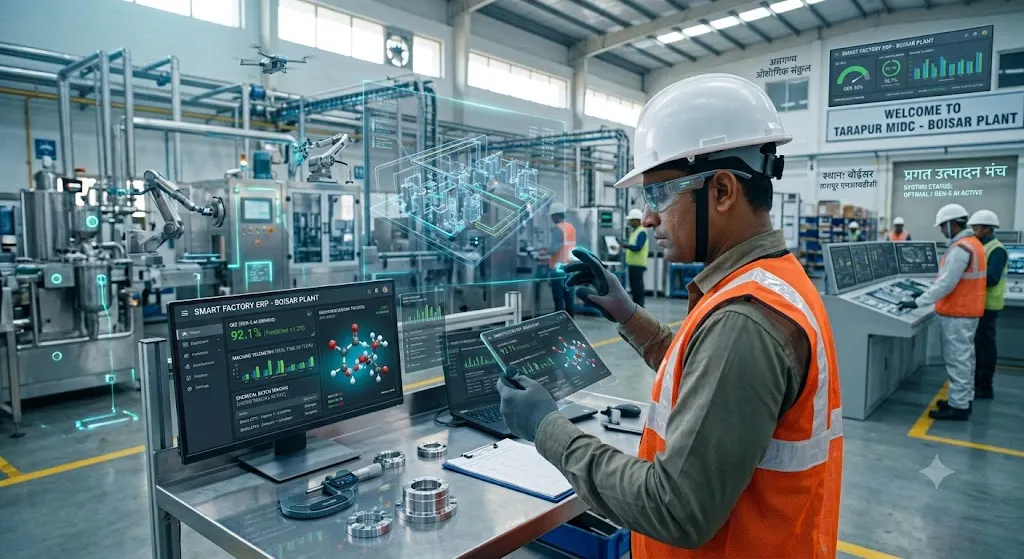
As one of Maharashtra’s premier industrial corridors, Boisar anchored by the sprawling Tarapur MIDC is home to hundreds of manufacturing facilities spanning chemicals, pharmaceuticals, steel fabrication, and textiles. However, many production floors still struggle with fragmented data, manual machine logs, and disconnected back-office spreadsheets.
In an era of tight margins, volatile raw material costs, and stringent environmental scrutiny, operational friction directly cuts into the bottom line. Modernizing the production floor with smart software including tailored Enterprise Resource Planning (ERP), Industrial IoT (IIoT) integrations, and automated shop-floor management is no longer an experimental initiative; it is essential to achieving consistent throughput, zero-defect quality, and sustained profitability.
1. Real-Time Shop Floor Visibility and OEE Tracking
For decades, plant managers in Boisar have had to wait until the end of the shift or the following morning to evaluate output numbers. By the time machine downtime or bottlenecks are discovered, the production delay has already cost thousands of rupees.
Smart manufacturing software integrates directly with machine sensors and operator terminals to calculate Overall Equipment Effectiveness (OEE) in real time:
- Availability Tracking: The system logs exact idle times, separating planned maintenance from unexpected mechanical failures or power interruptions.
- Performance Monitoring: Digital dashboards contrast target cycle times against actual operational speeds, highlighting underperforming assembly lines instantly.
- Live Shift Dashboards: Supervisors monitor work-in-progress (WIP) on ruggedized floor tablets, allowing them to shift labor and resources dynamically before minor slowdowns halt the entire line.
2. Comprehensive Batch Traceability for Chemical and Pharma Plants
A substantial portion of Tarapur MIDC is dedicated to bulk drug manufacturers, active pharmaceutical ingredient (API) labs, and specialty chemical producers. For these plants, product quality is inseparable from strict regulatory adherence.
Generic software rarely captures the multi stage nuances of formulation, quarantine, and yield variances. Custom smart software automates end-to-end traceability:
- Automated Batch Records: From raw material staging and reactor vessel loading to finished packaging, every step is logged with immutable digital signatures.
- Recall Readiness: If an issue is flagged with a specific supplier's chemical lot, the system can pinpoint every finished batch containing that raw material within seconds, eliminating hours of manual ledger auditing.
- Potency and Yield Reconciliation: Formulations automatically adjust based on active ingredient potency assays, minimizing material waste and ensuring standard chemical concentrations.
3. Predictive Maintenance to Prevent Costly Stoppages
Unscheduled machine failure is one of the most expensive disruptions an industrial plant faces. In heavy engineering, textile spinning, or high pressure chemical reactions, waiting for a motor or compressor to fail halts upstream and downstream processes alike.
Smart software shifts plant maintenance from reactive firefighting to automated prevention:
- Condition-Based Alerts: By analyzing telemetry data such as vibration, operating temperature, and running hours, the software identifies early indicators of mechanical wear.
- Automated Work Orders: When a component crosses threshold limits, the platform automatically schedules maintenance, reserves the necessary spare parts from the inventory module, and assigns the job to available technicians.
- Extended Equipment Lifecycle: Proactive upkeep prolongs the operational lifespan of heavy machinery, maximizing return on capital investments.
4. Unified Inventory, BOMs, and Supply Chain Coordination
Disconnected inventory management often forces Boisar factories into a dual crisis: holding excess capital in dead stock while simultaneously facing critical production delays due to missing minor components.
Smart ERP platforms connect procurement directly with production schedules:
- Dynamic Bill of Materials (BOM): Multi-level BOMs calculate exact raw material requirements based on active sales orders and production quotas, preventing over-purchasing.
- Automated Reorder Triggers: When raw materials hit predetermined safety thresholds, purchase requisitions are instantly generated and routed for approval.
- Vendor Performance Analytics: The system tracks vendor lead times, reject percentages, and invoice discrepancies, providing procurement teams with objective data during price negotiations.
5. Streamlined Compliance and Environmental Safety Audits
Manufacturing units in Maharashtra face rigorous oversight from statutory bodies, including the Maharashtra Pollution Control Board (MPCB), labor inspectors, and GST authorities. Manual documentation leaves factories vulnerable to human error, missed filings, and severe penalties.
Smart software centralizes compliance workflows into a unified system:
- Effluent and Waste Tracking: Chemical and textile plants can track hazardous waste generation, storage volumes, and disposal handovers to authorized facilities with automated reporting formats.
- Automated E-Way Billing & GST: Integrated financial modules generate compliant tax invoices and e-way bills directly from dispatch logs, preventing transit delays at checkpoints.
- Standardized Standard Operating Procedures (SOPs): Role based access ensures that operators cannot advance to subsequent stages without confirming safety and QA checks, reducing workplace accidents and ensuring consistent quality.
Forward thinking manufacturers in Boisar are moving away from rigid, off-the-shelf software and manual paperwork. By deploying purpose built, intelligent software architectures, local industrial leaders are bridging the gap between back office management and the factory floor turning real-time operational data into their most reliable engine for sustainable growth.