
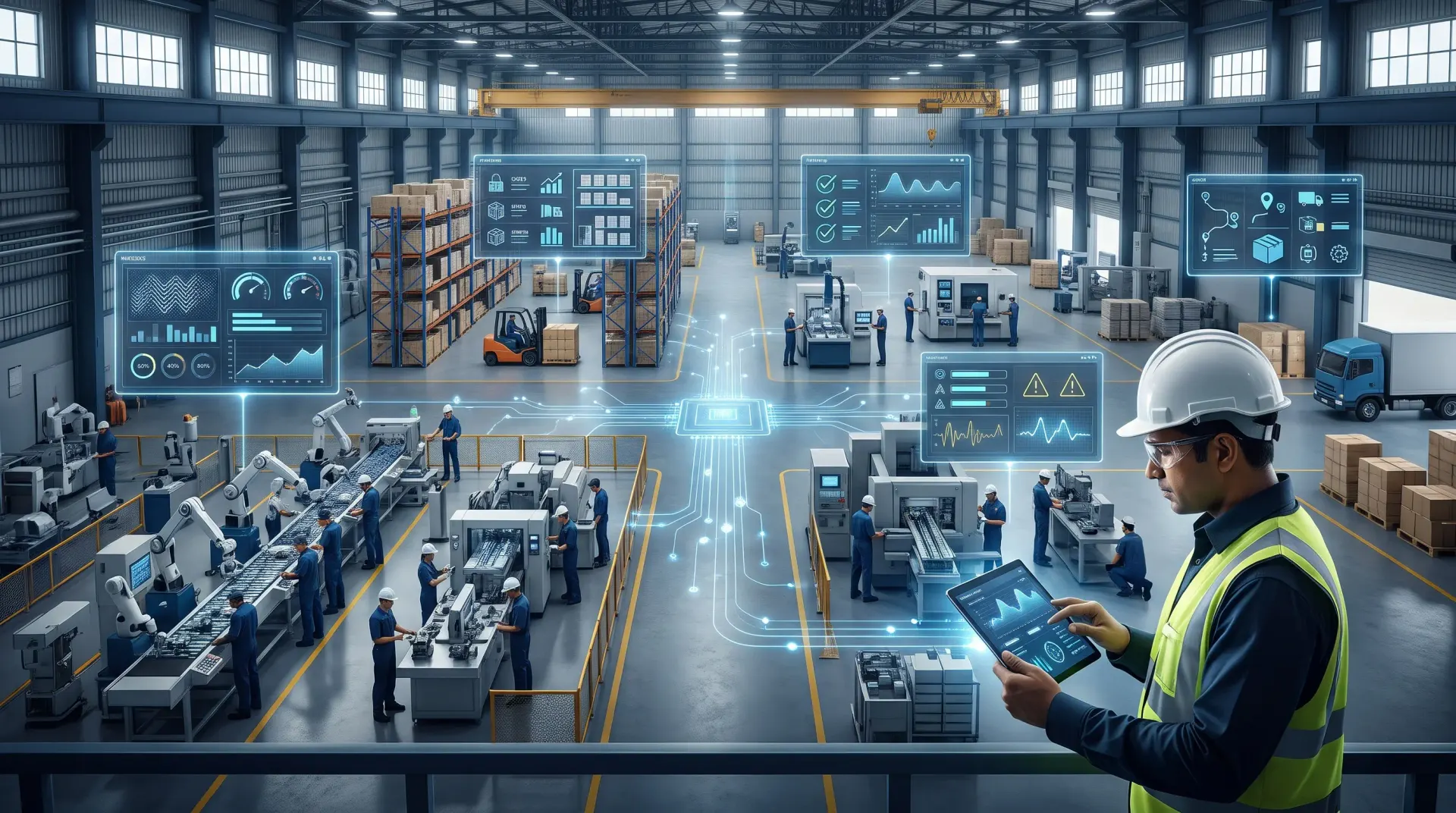
Manufacturing companies handle large amounts of information every day. Production teams record output, warehouse staff track raw materials, quality teams inspect products, and finance departments monitor costs. When these activities use separate systems, sharing accurate information becomes difficult.
For manufacturers in Palghar, Boisar and the Tarapur MIDC industrial area, this can create unnecessary delays. A production manager may not know whether materials are available, while the purchasing team may be working with outdated stock records. Finance may also struggle to calculate the actual cost of a production order.
The solution is not simply to introduce more software. It is to connect existing business processes through well-planned IT systems.
An IT company in Palghar can help manufacturing businesses understand these gaps and develop connected digital systems that allow departments to access consistent, useful information.
Why Manufacturing Companies Need Connected Production Data
A factory depends on several departments working together. Each department produces information that another department needs to complete its work.
For example, production needs material availability information from the warehouse. Quality control needs production details to inspect finished goods. Dispatch needs confirmation that products have passed inspection.
When these departments work with disconnected records, information becomes difficult to track.
Common problems caused by disconnected data
Manufacturing businesses may experience several problems:
- Delayed production updates: Supervisors record output manually, making it difficult for management to see current production status.
- Inventory mismatches: Warehouse records and production consumption figures may not match.
- Slow communication: Employees spend time calling or messaging other departments to confirm information.
- Repeated data entry: The same information is entered into multiple spreadsheets or applications.
- Delayed reporting: Management receives production reports only after employees collect and combine information.
- Limited cost visibility: Finance teams may not receive timely details about material usage, labour and production expenses.
These problems become more noticeable when a manufacturing business handles multiple products, shifts, production lines or locations.
Why spreadsheets alone may not be enough
Spreadsheets are useful for basic records and small operations. However, they become harder to manage as production activities increase.
Consider a factory that maintains separate spreadsheets for inventory, production planning and quality inspections.
If the production department changes an order quantity, the warehouse and finance teams may not receive the update immediately. Employees must manually communicate the change and update their own records.
A connected system can reduce these repeated steps by sharing approved information between departments.
How IT Systems Connect Different Manufacturing Departments
A well-designed manufacturing information system creates a common flow of information.
It does not mean every employee needs access to every record. Instead, each department receives the information required for its responsibilities.
Here is how connected systems can support important manufacturing functions.
1. Production Planning and Shop-Floor Operations
Production planning decides what needs to be manufactured, in what quantity and within which timeframe.
A digital production management system can record:
- Production orders and job numbers.
- Product specifications.
- Planned production quantities.
- Assigned machines and workstations.
- Shift schedules.
- Production start and completion dates.
- Work-in-progress status.
- Actual production quantities.
Once production begins, supervisors can update the progress of each order.
For example, a manufacturing unit in Boisar receives an order for 5,000 components. The production team creates an order with a planned completion date and assigns the required resources.
As work progresses, supervisors record completed quantities and any production delays.
Management can then compare planned output with actual output without waiting for multiple departments to prepare separate reports.
The production department should share order status, material requirements, actual output and completion updates with the relevant teams.
This allows purchasing, inventory and dispatch teams to plan their activities using the same production information.
2. Inventory and Warehouse Management
Production depends on the availability of raw materials, components and packaging supplies.
If inventory information is inaccurate, manufacturers may purchase materials they already have or discover shortages after production has started.
An integrated inventory system can connect warehouse records with production orders.
Important information includes:
- Available raw material quantities.
- Material received from suppliers.
- Material issued to production.
- Material consumed during manufacturing.
- Rejected or damaged materials.
- Finished goods inventory.
- Reorder levels and pending purchase orders.
For example, when a production order requires 500 units of a particular raw material, the system can show whether sufficient stock is available.
When materials are issued, the inventory records can be updated through an approved transaction.
Microsoft's documentation explains how ERP and manufacturing execution systems can exchange production and material-consumption information, helping keep inventory records current for other business processes. Read the Microsoft MES integration guide.
This connection helps warehouse and production teams work with consistent stock information.
3. Quality Control and Inspection
Quality control is another important part of manufacturing.
Products must meet defined specifications before they move to the next production stage or reach customers.
However, quality records may remain separate from production records in many factories.
A connected quality management process can maintain:
- Inspection results.
- Product specifications.
- Batch and lot numbers.
- Rejection quantities.
- Defect categories.
- Corrective actions.
- Inspection dates.
- Approval status.
Consider a chemical manufacturing unit where a particular batch fails a quality inspection.
The quality team records the inspection result against the batch number. Production managers can review the issue and identify the affected production order.
The warehouse team can also identify whether related materials or finished goods need to be held for further checks.
This improves traceability and reduces dependence on manual communication.
Batch-level tracking is especially useful for chemical, pharmaceutical, food processing and other industries where materials and finished products must be traced.
A system should connect material batches, production activities, inspection records and finished goods wherever the business process requires it.
4. Maintenance and Equipment Management
Unexpected machine downtime can affect production schedules, delivery commitments and operating costs.
Maintenance teams need accurate equipment information to plan inspections and repairs.
An integrated system can maintain:
- Equipment identification details.
- Maintenance schedules.
- Breakdown reports.
- Repair history.
- Spare parts requirements.
- Maintenance expenses.
- Machine availability.
For example, if a machine stops during a production shift, the supervisor can record the breakdown against the relevant equipment.
The maintenance team receives the issue and updates its status after inspection or repair.
Production managers can review the expected recovery time and adjust their schedules if required.
Where suitable machine sensors are available, additional data can also be collected automatically. However, automated monitoring requires compatible equipment, reliable connectivity and appropriate integration.
5. Procurement and Supplier Coordination
Purchasing teams need information about upcoming production requirements and current inventory levels.
Without connected records, purchasing decisions may depend on incomplete spreadsheets or messages from production supervisors.
A connected procurement workflow can provide:
- Material demand from production orders.
- Available warehouse stock.
- Minimum stock levels.
- Pending purchase orders.
- Supplier information.
- Expected delivery dates.
- Purchase approval status.
For example, if an upcoming production order requires materials that are not available in the warehouse, the system can highlight the shortage.
The purchasing team can then review the requirement and initiate the appropriate purchasing process.
This helps connect production planning with procurement decisions.
6. Finance, Costing and Management Reporting
Manufacturing costs are influenced by raw materials, labour, machine usage, maintenance and other operating expenses.
Finance teams need information from different departments to understand these costs.
A connected business system can bring together:
- Material consumption records.
- Production quantities.
- Labour costs.
- Machine maintenance expenses.
- Rejected material costs.
- Finished goods values.
- Production-related purchase expenses.
Management can use this information to review the cost of individual production orders.
For example, if a product requires more raw material than planned, managers can compare actual consumption with the original estimate.
This helps identify unusual variations and investigate their causes.
The main benefit is that information does not need to be collected manually from every department before a report can be prepared.
ERP and MES: Understanding the Difference
Two important technologies used in manufacturing data management are Enterprise Resource Planning (ERP) and Manufacturing Execution Systems (MES).
ERP software manages wider business processes such as purchasing, inventory, finance, sales and production planning.
MES software focuses more closely on manufacturing execution. It helps track production orders, shop-floor activities, material consumption and output.
These systems can work together.
For example:
- ERP creates or manages a production order.
- The order is shared with the MES.
- The shop floor records production activity.
- The MES sends output and material-consumption information back.
- ERP updates the relevant business records.
SAP and Microsoft both document ways to integrate ERP and manufacturing execution systems to support information exchange between planning and factory operations.
SAP Help Portal+1
Not every factory needs a separate MES. A smaller manufacturing unit may begin with a suitable ERP system and basic production tracking. The right approach depends on the complexity of its operations.
Key Features to Consider in Manufacturing Software
Manufacturers should evaluate software based on their actual production requirements rather than selecting a platform simply because it has many features.
The following capabilities are worth considering.
Centralized production dashboard
A dashboard should provide a useful overview of important factory activities.
Possible indicators include:
- Planned versus actual production.
- Pending production orders.
- Material shortages.
- Rejected quantities.
- Machine downtime.
- Work-in-progress.
- Finished goods availability.
Managers should be able to identify important issues without opening several separate reports.
Role-based access
Different departments have different responsibilities.
For example, warehouse employees may update stock transactions, while quality managers approve inspection records.
Role-based access helps ensure employees see and update only the information relevant to their responsibilities.
Automated notifications and approvals
A system can notify the appropriate employee when an important action is required.
Examples include:
- A production order is delayed.
- Inventory falls below a defined threshold.
- A quality inspection requires approval.
- A purchase request is pending.
- A maintenance task is overdue.
Notifications should be based on meaningful business events rather than sending unnecessary alerts.
Reporting and data analytics
Manufacturing managers need more than a list of transactions.
They need reports that explain what is happening across production operations.
Useful reports may include:
- Daily production summaries.
- Material consumption reports.
- Department-wise performance.
- Rejection and defect reports.
- Machine downtime summaries.
- Production cost comparisons.
These reports help management identify patterns and make better operational decisions.
How Manufacturing Companies in Palghar Can Implement Connected IT Systems
Introducing a new system across every department at once can create unnecessary complexity.
A phased approach is often more practical, especially for small and medium-sized manufacturers.
Step 1: Identify existing data gaps
Start by reviewing how departments currently collect and share information.
Ask questions such as:
- Where are production orders recorded?
- How does the warehouse receive material requirements?
- How are quality results communicated?
- How does management receive daily production reports?
- Which records are entered more than once?
This helps identify the most important integration problems.
Step 2: Map departmental workflows
Document how information moves from one department to another.
For example:
A sales order creates a production requirement. Production checks material availability. Procurement arranges shortages. The factory completes manufacturing. Quality approves the goods. Dispatch prepares the shipment.
Understanding this sequence helps determine which information needs to be shared and when.
Step 3: Choose the right software approach
Depending on the business, suitable options may include:
- Existing ERP software with additional integrations.
- Custom production management applications.
- Inventory and warehouse management systems.
- Manufacturing execution software.
- Business intelligence dashboards.
- APIs connecting different business applications.
A business should not replace every existing application if a reliable integration can solve the problem.
Step 4: Start with one important workflow
Choose a process that creates frequent delays or reporting problems.
For example, begin by connecting production orders with inventory records.
Test whether material requirements, issued quantities and stock balances remain consistent.
Once the process works reliably, expand the system to quality, procurement, maintenance and finance.
Step 5: Train employees and review data quality
Technology alone cannot guarantee accurate records.
Employees must understand how to enter information, update statuses and follow approval processes.
The business should also define standard product codes, material names, batch numbers and department responsibilities.
Without consistent data, even advanced software can produce confusing reports.
Common Mistakes to Avoid
Manufacturing businesses should watch out for these implementation mistakes:
- Digitizing poor processes: Automating an unclear workflow can create more confusion.
- Ignoring employee requirements: Software that is difficult to use may not be adopted by factory teams.
- Keeping duplicate records: Multiple versions of the same information create inconsistencies.
- Ignoring system integration: A new application should fit into the wider business technology environment.
- Overcomplicating the first phase: Start with essential workflows before adding advanced features.
- Neglecting data security: Access controls, backups and appropriate security practices are important for business information.
The objective should be to create a dependable information flow, not simply to purchase another software product.
How Unovative Can Help
Manufacturing companies do not always need to replace their entire technology environment to improve information sharing. In many cases, connecting existing applications or developing a suitable business application is a more practical starting point.
Unovative is an IT and AI software company based in Palghar, Maharashtra, with an international presence in Vietnam. It works on custom software, enterprise applications, automation and digital product development.
An IT company in Palghar can help manufacturers assess their current processes and identify where software integration can improve departmental coordination.
Custom enterprise applications
Some manufacturers have workflows that standard software does not fully support.
Custom enterprise applications can be designed around specific business requirements, including:
- Production order tracking.
- Department-wise information sharing.
- Inventory and material movement.
- Quality inspection records.
- Approval workflows.
- Centralized management dashboards.
Explore Unovative's Enterprise Application Services to understand its approach to connected business systems.
Digital transformation and workflow improvement
A Digital Transformation company in Palghar can help businesses review existing processes, modernize applications and reduce unnecessary manual work.
For manufacturers, this may involve connecting older business applications, improving information exchange and introducing more structured digital workflows.
The right approach depends on existing infrastructure, business requirements and the level of integration needed.
Business intelligence and data analytics
Once production information is properly collected, businesses can use dashboards and analytics to understand their operations.
For example, management may want to review production output, inventory movement, rejection rates and operating expenses together.
An IT and business technology partner can help assess the data requirements and identify suitable reporting solutions.
If a business needs an ERP Software Development Company to develop or extend its existing business systems, the first step should be to document its workflows, integration requirements and reporting needs.
For manufacturers in Palghar, Boisar and surrounding industrial areas, Unovative can help explore suitable technology approaches based on these requirements.
Learn more about Unovative's digital transformation services, or contact Unovative to discuss your business requirements.
Conclusion
Manufacturing data becomes more valuable when departments can access accurate and timely information.
Connecting production, inventory, quality, maintenance, procurement and finance helps businesses reduce manual coordination and improve operational visibility.
Companies do not need to modernize every department at once. They can begin with one important workflow, establish reliable data practices and gradually connect other business processes.
For manufacturers looking for an IT company in Palghar, the important consideration is finding a technology approach that matches their actual factory operations.
A well-planned system should make information easier to access, simplify everyday work and help management make decisions using dependable business data.