
You have a great idea for a new software product. You want to build it quickly. You want to get it into the hands of your users. But rushing straight into full development can be very risky.
Building software costs time and money. If you guess what your users want, you might build the wrong thing. You might also choose the wrong technology. To avoid these expensive mistakes, you need to test your ideas first.
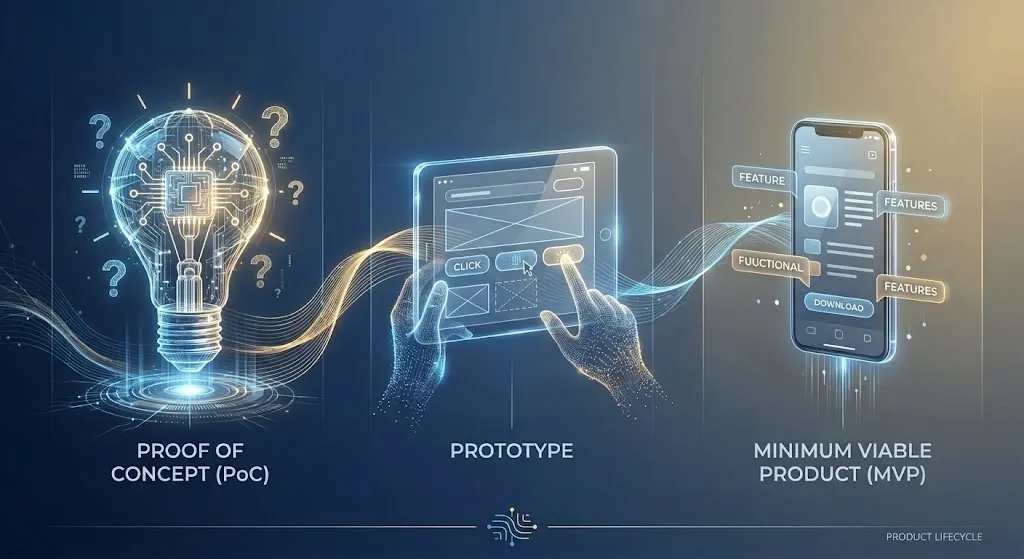
This is where a Proof of Concept (PoC), a Prototype, and a Minimum Viable Product (MVP) come in. Many people use these terms as if they mean the same thing. They do not. Each step serves a very different purpose. Each one answers a different question about your business idea.
Let us explore what each term means. We will look at how they work, why they matter, and which one you should build first.
The High Cost of Guessing in Software Development
Many businesses want to digitize their operations. They want custom software to solve specific problems. But they often skip the planning stages. They jump right into coding.
This approach often leads to failure. The software might look great but fail to do the job. Or the underlying technology might not support the required features. Sometimes, businesses build tools with too many complex features that nobody actually uses.
You can prevent these issues. You do this by validating your ideas step by step. You test the technology. You test the design. Finally, you test the market. This is the exact path of moving from a PoC to a Prototype, and then to an MVP.
What is a Proof of Concept (PoC)?
A Proof of Concept (PoC) tests a single technical idea. It answers one main question: "Can we actually build this?"
A PoC does not look pretty. It does not have a user-friendly interface. It is a small, internal project. You build it just to see if a certain technology works for your specific problem.
When Do You Need a PoC?
You need a PoC when you are trying something new. If you are using a standard technology, you might not need one. But if you are using complex systems, a PoC is vital.
For example, imagine a manufacturing company in the Tarapur MIDC area. They want to use artificial intelligence to read messy, handwritten invoices. Before building a full accounting system, they need to know if the AI can actually read the handwriting.
They build a small PoC. The developers feed a few scanned invoices into an AI script. If the AI reads the data correctly, the PoC is a success. The technical risk is gone.
Key Benefits of a PoC
- Finds limits early: It shows what the technology can and cannot do.
- Saves money: It stops you from investing in a project that is technically impossible.
- Builds confidence: It proves to stakeholders that the core idea works.
What is a Prototype?
A Prototype focuses on the user experience. It answers the question: "How will this look and feel?"
While a PoC tests the technology, a Prototype tests the design. It is usually a clickable model of your software. It shows where the buttons go. It shows how a user moves from one screen to the next.
A Prototype usually does not have working code in the background. If you type data into a Prototype, it does not save to a real database. It is a visual mockup.
When Do You Need a Prototype?
You need a Prototype to show your idea to others. It helps investors, managers, and potential users visualize the final product.
Think about a retail business in Palghar wanting a custom inventory app. They want their staff to scan barcodes with their phones. Before writing any code, designers create a Prototype. They draw the screens. They link them together.
The staff clicks through the Prototype on their phones. They might say, "This button is too small," or "We need a screen to show low stock." The business fixes these design issues before the actual coding begins.
Key Benefits of a Prototype
- Improves design: It helps you find design flaws before writing expensive code.
- Gathers early feedback: Users can tell you what they like and dislike about the interface.
- Aligns the team: Everyone gets a clear picture of what the final software will look like.
What is a Minimum Viable Product (MVP)?
A Minimum Viable Product (MVP) is a working piece of software. It answers the final question: "Will people actually use this and pay for it?"
An MVP is not a rough draft. It is a real product. However, it only includes the core features. It has just enough value to solve the user's main problem. You do not add extra, fancy features to an MVP. You launch it quickly to test your business model.
When Do You Need an MVP?
You need an MVP when you are ready to launch. You have proven the technology with a PoC. You have fixed the design with a Prototype. Now, you need real users.
Imagine a startup wanting to launch a new food delivery app in Maharashtra. A full app might have driver tracking, complex loyalty points, and custom avatars. But the MVP only has three features. Users can view a menu, place an order, and pay.
They release this simple MVP to early users. If people use the app to order food, the business model is validated. The startup can then add the tracking and loyalty points later.
Key Benefits of an MVP
- Fast market entry: You launch your product much faster.
- Real user data: You learn exactly how real people use your software.
- Reduces financial risk: You only spend money building features that users actually want.
The Step-by-Step Path to Success
Building successful software is a journey. You do not always need all three steps. But understanding the order is very helpful.
- Start with the PoC: If you have a complex technical problem, test the math or the code first. Fix the technical risks.
- Move to the Prototype: Once you know the tech works, design the screens. Make sure the software is easy to navigate. Fix the design risks.
- Launch the MVP: With the tech proven and the design tested, build the core product. Release it to users. Fix the business risks.
Common Mistakes to Avoid
Many businesses still make errors when planning custom software development. Here are a few things you should avoid.
Do not make your PoC pretty. A PoC is for developers to test code. Do not waste time making it look nice. Focus only on the technical result.
Do not overbuild your Prototype. A Prototype does not need a real database. It just needs to show the flow. Keep it simple and easy to change.
Do not add extra features to your MVP. This is the most common mistake. People want their MVP to be perfect. They keep adding just one more feature. This delays the launch. Stick to the core features only.
How Businesses Use This Approach
This step-by-step method works for all types of software. It works for enterprise applications. It works for customer apps. It works for digital transformation projects.
For example, many local businesses in Palghar and Mumbai are moving away from paper records. They need business automation tools. If a logistics company wants an AI system to plan delivery routes, they should start small.
They should run a PoC to test the routing logic. They should build a Prototype so drivers can test the app interface. Finally, they should launch an MVP with just a few drivers. This careful approach saves money. It ensures the final software actually helps the business grow.
Finding the Right Technology Partner
Choosing the right approach can feel overwhelming. You have to balance technical needs, user experience, and business goals. This is why having an experienced technology partner is so important.
A good software development company will not just write code. They will help you plan. They will tell you if you need a PoC. They will help you design a Prototype. They will guide you in choosing the right features for your MVP.
They help you manage risks at every stage of the process.
Conclusion
A Proof of Concept, a Prototype, and an MVP are all valuable tools. They just do different jobs.
A PoC proves your technology works. A Prototype proves your design is good. An MVP proves your business idea has a real market.
By using these tools correctly, you stop guessing. You make smart, data-driven decisions. You build software that people actually want to use. You save time, reduce costs, and increase your chances of long-term success.
If you are exploring how to implement custom software or AI solutions for your business, Unovative can help you evaluate the technical requirements, identify the right approach, and plan the next steps.