
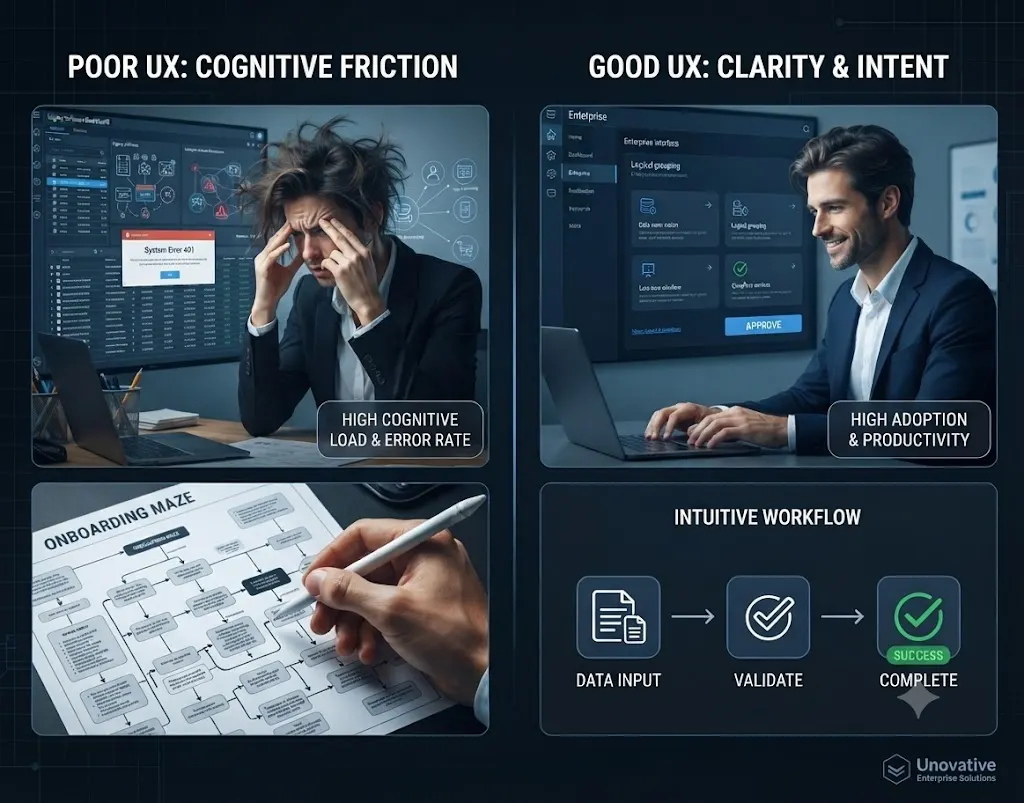
For decades, enterprise software was defined by a grim trade-off: powerful functionality came paired with punishing, unintuitive user interfaces. Employees were expected to endure steep learning curves, dense navigation trees, and endless data-entry screens simply because the software was mission-critical.
Today, that paradigm is shifting. As companies demand higher efficiency and faster onboarding, user experience (UX) has emerged as a critical determinant of enterprise software success. Poor UX is no longer just an aesthetic inconvenience - it is a direct drain on productivity and operational ROI.
1. The Hidden Cost of Cognitive Friction
When internal software is difficult to use, the friction accumulates across every department and daily workflow:
- Productivity Drag: Employees spend valuable hours wrestling with complex interfaces, clicking through unnecessary menus, and hunting for misplaced data fields instead of focusing on high-value tasks.
- Onboarding Bottlenecks: Steep learning curves stretch training timelines. New hires take weeks longer to become fully operational when software requires memorizing rigid, counterintuitive pathways.
- Error Rates: Complex, cluttered layouts invite human error. In critical operations - whether financial reporting, logistics, or compliance - a misclicked field in a poorly designed form can cascade into costly mistakes.
2. Adoption is Not Optional in the Enterprise
Unlike consumer apps, where users can simply uninstall a poorly designed product, enterprise software is mandatory. However, compliance with mandatory software does not equal effective adoption:
- Workarounds and Shadow IT: When enterprise tools are frustrating, employees find workarounds - such as exporting data into unauthorized spreadsheets or using external tools - which completely undermines data integrity and security governance.
- User Resistance: Forced adoption without regard for UX breeds friction and resentment among teams who feel the software hinders rather than helps their daily work.
3. Efficiency Through Clarity and Intent
Good enterprise UX is built on reducing cognitive load and respecting the user's workflow context:
- Streamlined Actions: Placing frequent actions front and center eliminates unnecessary navigation layers. A clean interface allows a user to complete a task in a single click rather than navigating a multi-step maze.
- Contextual Relevance: Modern enterprise tools use intelligent design to surface only the data and options relevant to the user's immediate role and task, filtering out system noise.