
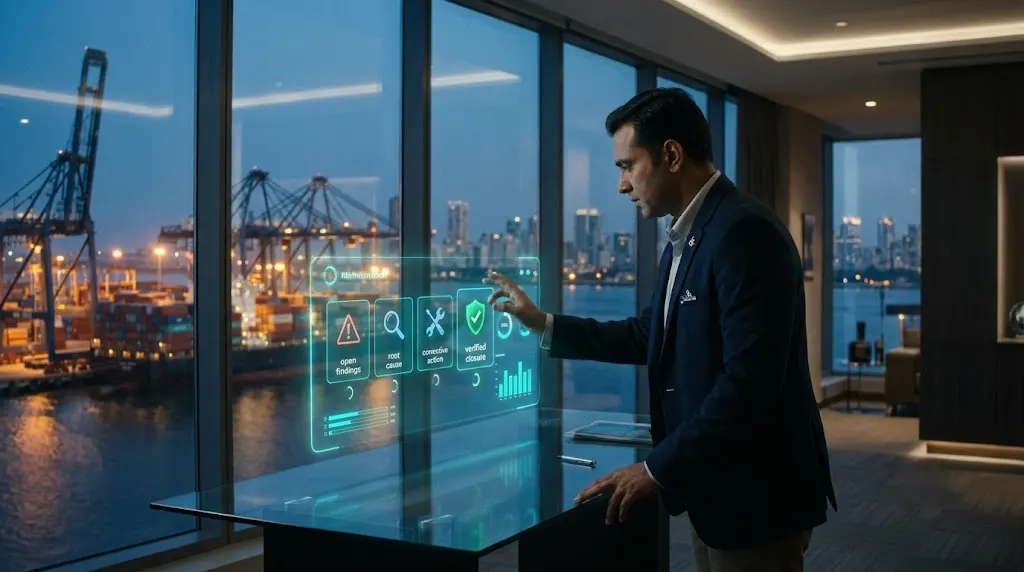
Every audit of a ship or shore office ends with a list of findings. Some are observations. Others are non-conformities that must be investigated, corrected, and closed with evidence.
For many ship operators, the audit day is not the hardest part. The real work happens in the weeks after it. This guide explains how corrective action software helps with that work. It also covers which features matter and what to ask a maritime software company in Mumbai before you build or buy a system.
Why Maritime Audit Findings Are Hard to Manage
A ship operator deals with many kinds of audits and inspections. These include internal ISM audits, flag or class audits for the Document of Compliance (DOC) and Safety Management Certificate (SMC), Port State Control inspections, vetting inspections, and customer audits.
Each one produces findings in its own format, with its own deadlines. Without a single system, the shore team ends up managing several separate lists.
The ISM Code sets the international standard for the safe management and operation of ships. When an audit finds a non-conformity, the company is responsible for deciding and starting the corrective action needed to fix the non-conformity or its cause. maritimenz
Findings are graded by seriousness. Under the amended Code, a major non-conformity is an identifiable deviation that seriously threatens personnel, the ship, or the environment and needs immediate corrective action. ukpandi
Fixing the visible problem is not enough. UK guidance on the amendment notes that corrective action must now remove the cause of the non-conformity so the problem does not recur, which means addressing its root cause. service
Time limits are strict. For ships under the Indian flag, a DG Shipping circular states that corrective action must be completed within a period agreed with the auditor that does not exceed three months, and non-conformities are not to be closed based only on the company’s proposals. dgshipping
Major findings carry even more pressure. IMO guidance says that a major non-conformity raised on a ship should be downgraded before the ship sails, and at least one additional audit should verify that the corrective actions are effective. liscr
Many operators still use spreadsheets, email threads, and scanned forms. This approach tends to fail in predictable ways:
- Scattered records: Findings, evidence, and approvals sit in different inboxes and folders.
- Unclear ownership: Nobody is sure who must act, on board or ashore.
- Weak root cause analysis: The fix targets the symptom, so the same finding returns at the next audit.
- Missed deadlines: Due dates are tracked manually and get overlooked during busy port calls.
- No fleet-wide view: Managers cannot easily see whether one problem affects several vessels.
- Poor evidence trail: At the next audit, the team struggles to show what was done and when.
How Corrective Action Software Supports the Audit Cycle
Corrective action software, often called CAPA (corrective and preventive action) software, gives the whole process one structured workflow. Here is how it typically works.
Every finding goes into a single register, whatever its source. Each record holds the vessel, audit type, date, ISM clause or SMS reference, grade, and description. Shipboard teams can log findings offline and sync when connectivity returns.
The system assigns each finding to a responsible person, such as the master, chief engineer, or a shore superintendent. Due dates follow the period agreed with the auditor. Automatic reminders and escalations warn managers before a deadline is missed.
A structured form guides users through root cause analysis, for example with “5 Whys” or a cause category list. This helps teams look past “crew error” toward the real issue, such as an unclear procedure, missing training, or a maintenance gap.
Each corrective action links to its proof: photos, revised procedures, training records, or maintenance work orders. The audit trail records who did what and when, which saves time at the next audit.
Closing a finding should take more than a click. The workflow can require a reviewer, such as the Designated Person Ashore (DPA), to confirm that the action worked before the record closes. Follow-up checks can be scheduled automatically.
Dashboards show open findings by vessel, category, and age. Trend reports reveal repeat issues, so a problem found on one ship can be prevented on the others. These insights also feed the management review that the ISM Code requires.
Where AI Can Help, and Where It Should Not
AI can make corrective action work faster. A well-designed AI solution for maritime industry in Mumbai and beyond can help in several ways:
- Suggest a category for a new finding based on its description.
- Surface similar past findings and the actions that resolved them.
- Draft summaries for management reviews.
- Flag findings at risk of missing their deadline.
AI should support decisions, not make them. Root cause conclusions, closure approvals, and responses to flag or class auditors must stay with qualified people. Any AI feature needs clear data access rules and a record of how its suggestions were used.
Build, Buy, or Customize?
Ready-made maritime software suites often include audit modules. They suit operators whose processes match the product’s workflow.
Other operators need something more specific. A ship management company in Mumbai that manages vessels for several owners may need separate reporting for each owner. Others need links to existing planned maintenance, crewing, or document systems. In these cases, working with a custom software development company in Mumbai or a specialist marine software development company in Mumbai can be more practical than reshaping internal processes around a generic tool.
Whether you work with a shipping software company in Mumbai or a wider IT partner, ask:
- Do they understand ISM audits, non-conformity grading, and closure rules?
- Can the system work offline on board and sync later?
- How will it integrate with your current maintenance, crewing, and document systems?
- What user roles, access controls, and audit trails are included?
- How will data be secured, backed up, and migrated from spreadsheets?
- Who supports the system after launch?
A good maritime software company in Mumbai should start by mapping your current audit process before it proposes features.
Practical Steps to Get Started
- Collect your current findings. Gather open and recently closed findings from all audit types into one list.
- Map your workflow. Document who raises, approves, acts on, and verifies each finding today.
- Define required fields. Agree on grades, categories, root cause options, and evidence types.
- Start with one audit type. Pilot with internal ISM audits before you add PSC and vetting findings.
- Train ship and shore users. Keep forms short so crews can log findings quickly.
- Review and improve. Use trend reports in management reviews and adjust the workflow as needed.
How Unovative Can Help
Unovative is an IT and AI software company headquartered in Palghar, Maharashtra, with an office in Ho Chi Minh City, Vietnam. For ship operators looking for an IT company in Mumbai or the wider Palghar region, Unovative can help plan and build software around real audit and compliance workflows.
Through its custom enterprise applications work, Unovative can develop a findings register, approval workflows, evidence management, and dashboards that fit your SMS. Its business AI and data analytics services can add carefully scoped AI features, such as finding categorization or trend analysis, with human approval kept in place.
Software supports compliance, but it does not make a vessel or company compliant on its own. Your SMS, flag-state requirements, and auditor instructions still apply, and any regulatory features should be confirmed during project planning. To see how this fits into a broader system, read our guide on how custom maritime software simplifies fleet management.
Conclusion
Audit findings are a chance to improve safety, but only if they are tracked, investigated, and closed with evidence. Corrective action software replaces scattered spreadsheets with one clear workflow. It covers capture, ownership, root cause, evidence, verification, and fleet-wide learning.
If your team is still chasing findings through email, now is a good time to review the process. Working with a maritime software company in Mumbai that understands both software and shipping makes the change easier. Book a 30-minute intro call with Unovative to discuss your audit workflow and the next practical step.